
Every 26th of January brings that special energy to Indian schools—the flag hoisting, patriotic songs, and the unmistakable pride of celebrating our Republic Day. But behind every smooth, memorable celebration stands one crucial element: the anchor. If you’re a teacher tasked with anchoring this important event, you know the pressure of getting those opening lines just right.
The truth? A well-written anchoring script isn’t just about reading words. It’s about weaving together the spirit of patriotism with clear program flow, keeping your audience engaged from the first “Good morning” to the final “Jai Hind.”
This guide gives you everything you need to anchor like a pro. We’ve crafted practical scripts, delivery tips, and structures that actually work in real school settings.
Why Your Anchoring Script Matters More Than You Think
Before we dive into the actual words, let’s talk about why anchoring matters for Republic Day celebrations. Your role as an anchor goes beyond simply introducing performances or announcing segments.
You’re setting the emotional tone for the entire event. Students remember how you presented the significance of the Constitution, not just the information itself. Parents feel the patriotic spirit through your delivery. Teachers appreciate the smooth transitions that keep the program running on schedule.
A poorly written script leads to awkward silences, confused transitions, and—worst of all—a diluted message about the importance of our Republic. A well-crafted script? It creates an unforgettable experience where every person in that assembly hall feels connected to the values our Constitution stands for.
What Makes an Effective Republic Day Anchoring Script
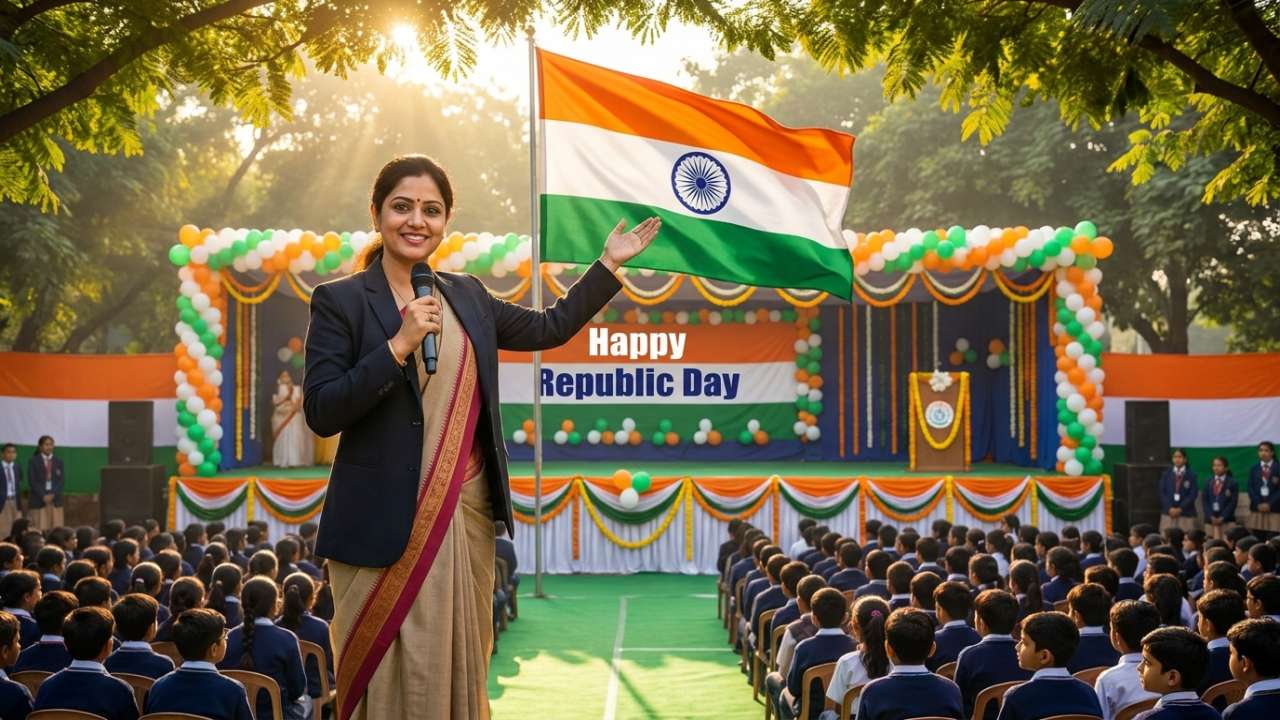
Good anchoring scripts share common features. Let’s break them down so you understand the framework before we show you actual examples.
Clear Structure: Your script should have a recognizable flow—welcome, significance, flag hoisting, performances, speeches, concluding remarks. This structure keeps both you and your audience oriented.
Warm, Natural Tone: Avoid robotic language. You want to sound like an experienced teacher who genuinely cares about this celebration, not a news reader following a teleprompter.
Historical Context: Reference the actual significance of January 26, 1950—when our Constitution came into effect. Knowing this history adds authenticity to your words.
Audience Engagement: Include moments where you interact with the audience—asking them to stand, inviting applause, creating pauses for reflection.
Flexibility: Your script should have spots marked [Name], [Class], or [Time] where you can personalize it for your school.
Complete Republic Day Anchoring Script for School Teachers
Here’s a full script you can adapt for your school. Read through the entire thing first, then customize the bracketed sections with your specific details.
Opening and Welcome
“Good morning, everyone! I hope all of you are doing wonderfully on this bright, beautiful day. On behalf of our entire school community, I extend a warm welcome to our respected Principal Sir/Madam, our honored Chief Guest [Chief Guest’s Name], all our esteemed teachers, parents, and most importantly, our wonderful students.
My name is [Your Name], and I’m honored to be your host for today’s celebration—a day that fills every Indian heart with immense pride and joy.
Today is the 26th of January, a date that holds extraordinary significance in our nation’s history. On this very day in 1950, India officially became a sovereign, democratic republic when our Constitution came into effect. This wasn’t just a legal document being adopted—it was the moment when ‘We the People of India’ claimed our right to govern ourselves with liberty, justice, and equality.”
Explaining the Significance
“Students, I want you to understand why this day matters so deeply. Think about it—just three years after gaining independence from British rule, our leaders and constituents drafted the longest Constitution in the world. Dr. Bhimrao Ambedkar, often called the architect of our Constitution, worked tirelessly with hundreds of others to create a document that protects the rights of every single Indian citizen.
That Constitution guarantees you the right to education, freedom of speech, and equality before law. It doesn’t matter if you’re from Kashmir or Kanyakumari, whether you speak Hindi, Tamil, or any of our 22 official languages—the Constitution protects your rights equally.
This is what makes Republic Day more than just a national holiday. It’s a reminder of the dreams our freedom fighters had for India, and it’s our responsibility to honor those dreams through our actions.”
Flag Hoisting Transition
“Now, we come to the most solemn moment of our celebration—the hoisting of our beloved Tricolor. I request everyone to please stand in respect. The saffron represents the courage and sacrifice of our freedom fighters. The white stands for truth, peace, and purity. The green symbolizes the fertility and prosperity of our land.
I humbly request our Chief Guest, [Chief Guest’s Name], along with our Principal Sir/Madam, to do us the honor of hoisting our national flag.”
[Pause for flag hoisting]
“As our flag flutters majestically in the sky, let us take a moment to remember those brave souls who sacrificed everything so we could live as free citizens. Let us sing our National Anthem with full respect and pride.”
[Allow for National Anthem]
How to Transition Between Program Segments Smoothly
One of the biggest challenges for new anchors is moving from one program item to the next without awkward pauses. Here’s the framework you can use:
After Each Performance: “Thank you so much for that beautiful [type of performance]! The way you [specific observation about what they did] truly captured the spirit of unity and patriotism that defines our nation. Let’s give them another round of enthusiastic applause.”
Introducing Performances: “Our next performance is [name and theme]. This [song/dance/skit] is about [what it represents]. Please welcome [performer names/class names] to the stage.”
Before Major Announcements: “Now, we have something special lined up. Before that happens, let me share a quick fact with you all…”
This structure prevents those dreaded awkward silences while keeping your audience engaged.
Announcing Important Moments: Key Phrases That Work
Introducing the Chief Guest
“We are truly blessed to have with us someone whose contributions to [field/community] are widely recognized and deeply respected. [He/She] has consistently shown dedication to education and community development. Please join me in giving the warmest welcome to [Guest Name].”
Welcoming Cultural Performances
“Culture is the heartbeat of India. From the snow-capped mountains of Kashmir to the coastal shores of Kerala, our country is a living tapestry of different traditions. Our next performance celebrates this beautiful diversity. Let’s welcome our talented students who will present a [classical/folk] dance showcasing [specific region or theme].”
Transitioning to Patriotic Songs
“Music has a unique power—it can touch hearts in ways that words sometimes cannot. Our school choir has prepared a specially selected patriotic song that captures the essence of our nation’s values. The melody might be familiar, but as you listen, I encourage you to think about what these words truly mean. Please welcome our singers.”
Common Challenges Teachers Face While Anchoring (And How to Fix Them)
Challenge 1: Forgetting Your Lines Mid-Speech
Solution: Write cue cards with just the opening line of each section, not every single word. Practice enough that you know the flow, then trust yourself. Your natural conversational voice is more engaging than reading every word verbatim.
Challenge 2: The Audience Seems Disengaged
Solution: Ask rhetorical questions. “Do you know how many years our Constitution was in the making?” (Pause for effect.) “Eight years! From 1947 to 1950, hundreds of people worked on this document.” Questions activate audience brains and pull them into your narrative.
Challenge 3: Running Over Time
Solution: Mark your script with time checks. Write “5 minutes until now” at certain points. During rehearsal, practice with a timer. Have shortened versions of each section prepared in case you need to trim.
Challenge 4: Dry Mouth or Nervous Shaking
Solution: Keep a glass of water at the podium (out of view). Take slow, deep breaths before starting. Remember—you know your school community. They’re rooting for you to succeed.
Comparison: What Makes a Strong vs. Weak Anchoring Script
| Element | Strong Script | Weak Script |
|---|---|---|
| Opening | Warm, specific greeting | Generic “Good morning everyone” |
| Information | Historical context provided naturally | Just facts, no connection to audience |
| Tone | Conversational, genuine | Formal, robotic, reads like news |
| Transitions | Smooth, purposeful | Abrupt, jarring |
| Engagement | Audience interaction built in | Passive audience throughout |
| Closing | Inspiring, memorable | Rushed, anticlimactic |
| Personalization | School/community specific details | Generic, could be used anywhere |
Practical Tips for Delivery That Actually Makes Impact
Speak Like You’re Having a Conversation: Imagine you’re talking to a friend, not reading to strangers. This changes your rhythm and makes people want to listen.
Pause Before Important Points: Don’t rush through significant information. “Our Constitution guarantees equality.” (Pause) “That means no Indian is greater or lesser than another.” The silence gives people time to absorb meaning.
Use Eye Contact Strategically: Look at different sections of the audience. When making a serious point, find a few faces and hold their eyes for a moment.
Control Your Pace: Nervous? You’re probably speaking too fast. Practice speaking slightly slower than feels natural to you. It gives power to your words.
Emphasize Key Words: Not by shouting, but by speaking them with slight pause before and after. “Today we celebrate the day our Constitution—came into effect.” The slight stress on “Constitution” keeps focus there.
Frequently Asked Questions About Republic Day Anchoring Scripts
Q: Can I use a mix of English and Hindi? A: Absolutely. Many schools do this effectively. If your school is bilingual or multilingual, mix languages naturally. Just ensure smooth transitions between languages and check that your audience understands both.
Q: How long should my entire script be? A: For a typical school assembly, aim for 8-12 minutes of actual anchoring (not including performances and speeches). This usually translates to 1500-2000 words when written out, but you won’t read it all verbatim.
Q: What if our chief guest wants to arrive late? A: Build flexibility into your script. You can move the flag hoisting to later or start with cultural performances and do a separate flag hoisting ceremony. Always have the chief guest’s schedule confirmed 2-3 days before.
Q: Should I include humor in a Republic Day script? A: Light, appropriate humor works well. Avoid jokes that trivialize patriotism or mock any group. Short, clever observations about school life or age-appropriate wordplay land well.
Q: What if I make a mistake while anchoring? A: Keep going smoothly as if nothing happened. Your audience won’t notice unless you make it obvious. Teachers will appreciate your professionalism and ability to recover.
Q: How do I handle unexpected interruptions during the program? A: Have bridging lines ready. If something runs late, you can say: “While we get our next performers ready, let me share something interesting about our Constitution…” This keeps momentum without awkwardness.
Q: Can I use these scripts for college/university celebrations? A: Yes, with modifications. Add references to current events, more sophisticated language, and perhaps examples relevant to college students rather than school children.
Q: What should I do about students who find patriotic speeches boring? A: Make it relevant to them. Instead of abstract patriotism, talk about how the Constitution protects their rights as students, their freedom to pursue education, and their future opportunities.
Q: How many times should I rehearse? A: Practice at least 3-4 times out loud. Once alone, once with a colleague listening, once in the actual venue at actual speaking volume, and once more the day before. Each practice session helps you own the words naturally.
Q: Is it okay to read directly from a script during the actual event? A: Reading the entire script sounds stiff. Use cue cards with key points instead. Write the opening and closing word-for-word, then use bullet points for the middle sections.
Also Read:-