
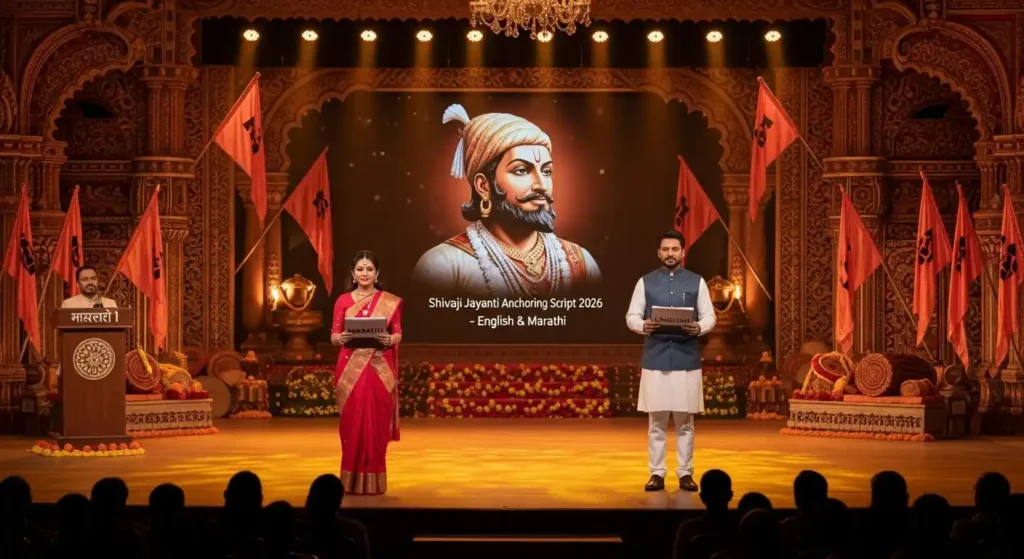
Shivaji Jayanti is one of the most important celebrations in India, especially in Maharashtra, commemorating the birth anniversary of the legendary warrior king Chhatrapati Shivaji Maharaj. Born on 19th February 1630 at Shivneri Fort, Shivaji Maharaj founded the Maratha Empire and became a symbol of courage, administration, and justice. This complete anchoring script is designed for schools, colleges, and cultural events to help hosts conduct a memorable and inspiring Shivaji Jayanti celebration.
Event Duration: 2-3 hours
Target Audience: Students, teachers, parents, and community members
Language: English (easy to understand and deliver)
Event Schedule Overview
| Time | Segment | Duration | Participants |
|---|---|---|---|
| 9:00 AM | Opening & Welcome | 10 minutes | Host 1 & Host 2 |
| 9:10 AM | Lamp Lighting Ceremony | 5 minutes | Dignitaries |
| 9:15 AM | Prayer/Invocation | 5 minutes | School Choir/Students |
| 9:20 AM | Welcome Speech | 10 minutes | Principal/Chief Guest |
| 9:30 AM | Speech on Shivaji Maharaj | 8 minutes | Selected Student |
| 9:38 AM | Cultural Dance Performance | 12 minutes | Dance Group |
| 9:50 AM | Drama/Skit | 15 minutes | Drama Team |
| 10:05 AM | Life Lessons Segment | 8 minutes | Host 1 & Host 2 |
| 10:13 AM | Interactive Quiz | 10 minutes | Hosts with Audience |
| 10:23 AM | Group Song | 7 minutes | All Students |
| 10:30 AM | Chief Guest Address | 15 minutes | Chief Guest |
| 10:45 AM | Vote of Thanks | 5 minutes | Host 1 & Host 2 |
| 10:50 AM | National Anthem | 3 minutes | Everyone |
| 10:53 AM | Closing | 2 minutes | Host 1 & Host 2 |
Section 1: Opening the Event with Energy and Respect
Opening Lines (Creating the Right Atmosphere)
The opening sets the tone for the entire event. Hosts should begin with high energy, clear voice, and confident body language.
Host 1:
“A very good morning to everyone present here! To our respected principal, beloved teachers, honored guests, and my dear friends – welcome to this special celebration!”
Host 2:
“Good morning, everyone! Today is not just another day. Today, we celebrate a legend, a warrior, a visionary leader who changed the course of Indian history!”
Host 1:
“A king who fought not for personal glory, but for the dignity and freedom of his people. A leader who established an empire built on justice, courage, and equality.”
Host 2:
“Ladies and gentlemen, today we gather here to honor the birth anniversary of the great Maratha warrior king…”
Both Hosts Together (with energy):
“Chhatrapati Shivaji Maharaj!”
Audience Participation (Building Energy)
Host 1:
“Let us all raise our voices together and pay our respects to this legendary king!”
Both Hosts:
“Chhatrapati Shivaji Maharaj Ki Jai!”
[Encourage audience to respond with “Jai!” – Repeat this 3 times with increasing volume]
Tips for Hosts:
- Maintain eye contact with the audience
- Use hand gestures to encourage participation
- Smile and show enthusiasm
- Speak clearly into the microphone
Section 2: Traditional Lamp Lighting Ceremony
Significance and Invitation
The lamp lighting ceremony symbolizes the victory of light over darkness, knowledge over ignorance – values that Shivaji Maharaj embodied throughout his life.
Host 2:
“Every auspicious occasion in Indian culture begins with lighting a lamp. This sacred flame represents the light of wisdom, courage, and righteousness that Chhatrapati Shivaji Maharaj brought into the world.”
Host 1:
“Today, as we light this lamp, we remember how Shivaji Maharaj illuminated the path of self-rule and dignity for millions of Indians.”
Host 2:
“I now request our esteemed dignitaries to kindly grace the stage for the lamp lighting ceremony. May I call upon:”
List of Dignitaries to Invite
- Chief Guest: [Name and Designation]
- Principal: [Name]
- Vice Principal: [Name]
- Senior Teachers: [Names]
- Special Guests: [Names if any]
Host 1:
“Please welcome them with a warm round of applause!”
[Play traditional instrumental music – preferably Marathi classical or tabla-flute combination]
During the Ceremony (Hosts can narrate)
Host 2 (while lamp is being lit):
“As these respected individuals light this sacred lamp, let us take a moment to reflect on the teachings of Shivaji Maharaj. Just as this flame dispels darkness, he dispelled injustice and oppression from his kingdom.”
Host 1:
“He showed us that true leadership means serving your people, protecting the weak, and standing up against tyranny.”
After Lighting:
Host 2:
“Thank you so much to all our respected guests. You may please take your seats on the dais.”
Host 1:
“What a beautiful and meaningful start to our celebration!”
Section 3: Prayer and Welcome Address
Prayer Segment
Host 1:
“Before we proceed further, let us seek the blessings of the Almighty. I request everyone present here – students, teachers, and guests – to please rise for the prayer.”
Options for Prayer:
- School/Institution prayer
- Universal prayer
- “Vande Mataram”
- Traditional Sanskrit shloka
[Prayer duration: 3-5 minutes]
Host 2:
“Thank you, everyone. You may kindly take your seats.”
Welcome Speech Introduction
Host 1:
“Now, I would like to invite our respected Principal, [Full Name], to share their thoughts on this special occasion and officially welcome all the guests.”
Host 2:
“Our Principal has always been a guiding light for all of us, inspiring us to follow the path of knowledge and righteousness. Sir/Madam, the stage is yours.”
[Principal delivers welcome speech: 7-10 minutes]
After the Speech:
Host 1:
“Thank you so much, Sir/Madam, for those truly inspiring words! Your message about following Shivaji Maharaj’s ideals will stay with us forever.”
Host 2:
“Let’s give a big round of applause to our Principal!”
Section 4: Understanding Shivaji Maharaj – Historical Context and Achievements
Introduction by Hosts
Host 2:
“Now, let me take you all on a journey – a journey back to the 17th century, to the majestic Western Ghats of Maharashtra, where a legend was born!”
Host 1:
“Born on February 19, 1630, at Shivneri Fort, young Shivaji grew up listening to stories of valor and dharma from his mother, Jijabai, and tales of administration from his father, Shahaji Bhonsle.”
Key Facts About Shivaji Maharaj (Hosts can present)
| Aspect | Details |
|---|---|
| Birth | 19 February 1630, Shivneri Fort |
| Parents | Shahaji Bhonsle (Father), Jijabai (Mother) |
| First Conquest | Torna Fort (1646, at age 16) |
| Coronation | 6 June 1674, Raigad Fort |
| Title | Chhatrapati (Paramount Sovereign) |
| Capital | Raigad |
| Empire | Maratha Empire |
| Death | 3 April 1680, Raigad Fort |
| Legacy | Over 300 forts, strong navy, efficient administration |
Host 2:
“To tell us more about the incredible life and achievements of Chhatrapati Shivaji Maharaj, I invite [Student Name] from [Class and Section].”
Host 1:
“Please welcome our speaker with a big round of applause!”
Student Speech (8-10 minutes covering)
Suggested Topics for Speech:
- Early life and training
- Military conquests and strategy
- Battle of Pratapgad (1659)
- Escape from Agra (1666)
- Coronation and establishment of Maratha Empire
- Administrative reforms (Ashtapradhan Mandal)
- Naval strength
- Respect for women and all religions
- Legacy and inspiration for freedom fighters
After Speech:
Host 2:
“Wow! That was absolutely fantastic! Thank you so much for such a detailed and inspiring presentation!”
Host 1:
“We learned so much about our great warrior king today. Let’s appreciate this wonderful effort with another round of applause!”
Section 5: Cultural Performances – Bringing History to Life
Performance 1: Traditional Dance
Host 2:
“You know, the glory of Shivaji Maharaj has been celebrated for over 400 years through folk songs, dances, and poems called ‘Powadas’.”
Host 1:
“These traditional art forms keep the spirit of the Maratha warriors alive in our hearts. And today, we are going to witness one such spectacular performance!”
Host 2:
“I invite our talented dancers from [Class/Group Name] to present a traditional dance performance dedicated to Chhatrapati Shivaji Maharaj!”
Dance Performance Types:
- Lavani (traditional Marathi folk dance)
- Koli dance (fishermen community dance)
- Powada dance (warrior dance)
- Classical fusion with historical theme
[Performance duration: 10-12 minutes]
After Performance:
Host 1:
“What an electrifying performance! The energy, the costumes, the expressions – absolutely mesmerizing!”
Host 2:
“I’m sure Chhatrapati Shivaji Maharaj would be so proud to see young talents celebrating his legacy with such passion!”
Host 1:
“Let’s give these amazing performers a standing ovation!”
Performance 2: Drama/Skit
Host 2:
“History truly comes alive when we enact it, when we step into the shoes of those great personalities and relive their moments of courage and wisdom.”
Host 1:
“Our drama team has prepared a powerful skit depicting one of the most famous incidents from Shivaji Maharaj’s life.”
Suggested Drama Themes:
- The Escape from Agra (1666)
- Shows Shivaji’s intelligence and bravery
- How he escaped Aurangzeb’s captivity
- Battle with Afzal Khan (1659)
- The famous encounter at Pratapgad Fort
- Strategy and courage in the face of danger
- Respect for Badi Begum Sahiba
- Shows Shivaji’s respect for women
- When enemy commander’s wife was captured
- The Coronation Ceremony (1674)
- Historical significance
- Establishment of Hindu Pad Padshahi
Host 2:
“Let’s welcome our drama team with an encouraging round of applause!”
[Drama performance: 12-15 minutes]
After Drama:
Host 1:
“That was absolutely powerful! The acting, the dialogues, the message – everything was perfect!”
Host 2:
“Through this performance, we truly understood what made Shivaji Maharaj so great – not just his sword, but his values!”
Section 6: Life Lessons from Chhatrapati Shivaji Maharaj
Interactive Lesson Segment
Host 1:
“Now, let’s pause for a moment and reflect on the timeless lessons that Shivaji Maharaj taught us through his life.”
Host 2:
“These are not just historical facts, but values that are relevant even today, 400 years later!”
10 Important Lessons (Presented by Hosts Alternately)
Host 1 – Lesson 1: Respect for Women
“Shivaji Maharaj had a strict policy – no woman, even from the enemy side, should be dishonored. When Badi Begum Sahiba, wife of enemy commander, was captured, he treated her with utmost respect and sent her back safely with honor.”
Host 2 – Lesson 2: Religious Tolerance
“His army had soldiers from all religions – Hindus, Muslims, and others. He never discriminated based on faith. He believed in unity and respect for all communities.”
Host 1 – Lesson 3: Strategic Thinking
“Shivaji Maharaj taught us that intelligence is more powerful than brute force. His guerrilla warfare tactics are studied even in modern military academies around the world!”
Host 2 – Lesson 4: Good Governance
“He established the ‘Ashtapradhan Mandal’ – a council of eight ministers with clearly defined responsibilities. This shows his commitment to systematic and accountable administration.”
Host 1 – Lesson 5: Importance of Navy
“He was one of the first Indian rulers to understand that a strong navy is essential for protecting coastal areas. He built a powerful naval fleet.”
Host 2 – Lesson 6: Love for Motherland
“His famous declaration ‘Swarajya is my birthright’ inspired millions of freedom fighters during India’s struggle for independence, including Bal Gangadhar Tilak.”
Host 1 – Lesson 7: Discipline and Training
“From childhood, he focused on physical fitness, horse riding, sword fighting, and strategic studies. He believed in constant self-improvement.”
Host 2 – Lesson 8: Care for Common People
“He reduced taxes during difficult times, ensured justice for all, and personally listened to people’s problems. He was truly a people’s king!”
Host 1 – Lesson 9: Environmental Conservation
“Shivaji Maharaj protected forests and wildlife. He understood the importance of maintaining ecological balance long before modern environmental movements!”
Host 2 – Lesson 10: Never Give Up
“Despite facing powerful enemies like the Mughals and Adilshahi, he never gave up on his dream of Swarajya. His perseverance teaches us to keep fighting for what is right!”
Host 1:
“These ten lessons are as relevant today as they were 400 years ago!”
Section 7: Interactive Quiz Competition
Making it Fun and Educational
Host 2:
“Now, let’s have some fun and test how much you’ve learned about Chhatrapati Shivaji Maharaj today!”
Host 1:
“We have an exciting quiz for you all, and yes, there are prizes for correct answers!”
Quiz Questions and Answers:
| Question | Answer |
|---|---|
| In which year was Shivaji Maharaj born? | 1630 |
| What was the name of his mother? | Jijabai |
| At what age did he capture his first fort? | 16 years (Torna Fort in 1646) |
| What was his coronation title? | Chhatrapati (Paramount Sovereign) |
| Where was his coronation held? | Raigad Fort (1674) |
| What was his administrative council called? | Ashtapradhan Mandal (Council of Eight Ministers) |
| Name the famous battle with Afzal Khan | Battle of Pratapgad (1659) |
| From which fort did he escape Mughal custody? | Agra Fort (1666) |
| How many forts did he capture approximately? | Over 300 forts |
| What was the name of his naval fleet? | Maratha Navy |
Host 2:
“Raise your hands if you know the answer! First one with the correct answer wins a prize!”
Host 1:
“Great participation, everyone! Let’s give a round of applause to all our smart participants!”
Section 8: Group Song and Closing Ceremony
Patriotic Group Performance
Host 2:
“As we approach the end of our celebration, let’s all come together and express our love and respect through music!”
Host 1:
“Music has the power to unite hearts and souls. Today, we shall sing together in honor of our great warrior king!”
Suggested Songs:
- “Vande Mataram”
- “Maa Tujhe Salaam”
- Shivaji Maharaj tribute song
- Any patriotic song
[All students and teachers participate: 5-7 minutes]
Chief Guest Address (if applicable)
Host 2:
“Now, I request our esteemed Chief Guest, [Name and Designation], to kindly share their valuable thoughts with us.”
[Chief Guest speech: 10-15 minutes]
Host 1:
“Thank you so much for your inspiring words and for gracing this occasion with your presence!”
Vote of Thanks
Host 2:
“As we conclude this wonderful celebration, it’s time to express our heartfelt gratitude.”
List of People to Thank:
- Principal and management
- All teachers and staff
- Chief guest and dignitaries
- All student participants (dancers, actors, speakers, singers)
- Technical team (sound, lights, stage)
- Decoration team
- Parents for support
- Audience for their presence
Host 1:
“Without everyone’s collective effort, this event wouldn’t have been such a grand success!”
Final Tribute and National Anthem
Host 2:
“Before we disperse, let us all stand together one final time and pay tribute to Chhatrapati Shivaji Maharaj!”
Both Hosts:
“Chhatrapati Shivaji Maharaj Ki Jai!”
[Audience responds: “Jai!” – Repeat 3 times]
Host 1:
“I request everyone to stand in attention for our National Anthem.”
[National Anthem – “Jana Gana Mana”]
Host 2:
“Thank you, everyone! May the spirit of Shivaji Maharaj guide us always!”
Both Hosts:
“Jai Hind! Jai Shivaji!”
Pro Tips for Successful Anchoring
Voice and Delivery
| Aspect | Tips |
|---|---|
| Voice Modulation | Vary pitch and tone – high energy for performances, serious for speeches |
| Speaking Speed | Not too fast, not too slow – clear and understandable |
| Pronunciation | Practice difficult names beforehand |
| Volume | Speak clearly into mic, maintain consistent volume |
Body Language and Presentation
- Stand Confidently: Good posture, shoulders back, chin up
- Hand Gestures: Use natural gestures to emphasize points
- Eye Contact: Engage with audience, don’t just read script
- Smile: Maintain friendly and welcoming expression
- Movement: Don’t stand rigid, move naturally but don’t pace
Coordination Between Hosts
- Practice Together: Rehearse transitions multiple times
- Don’t Interrupt: Wait for co-host to finish completely
- Support Each Other: If one forgets, the other covers smoothly
- Equal Participation: Distribute speaking time fairly
Attire Suggestions
For Boys:
- Traditional kurta-pajama with Nehru jacket
- White shirt with saffron/orange turban (Pheta)
- Traditional dhoti-kurta
For Girls:
- Traditional saree (preferably saffron/orange/white)
- Salwar kameez with dupatta
- Traditional lehenga
Colors to Prefer: Saffron, orange, white, yellow (representing Maratha flag colors)
Emergency Preparedness Checklist
What to Keep Ready
- Backup Script: Printed copies for both hosts
- Water Bottles: Stay hydrated, don’t let throat dry
- Filler Content: Extra jokes, facts, or stories in case of delays
- Time Management: Have a visible watch, stick to schedule
- Technical Contact: Know who to call if mic/sound fails
- Alternate Activities: Backup performances if something is canceled
Handling Common Issues
If mic fails:
- Don’t panic, project your voice loudly
- Signal technical team calmly
- Continue with alternate mic if available
If performance is delayed:
- Engage audience with Shivaji Maharaj facts
- Conduct impromptu quiz
- Share interesting anecdotes
If audience energy is low:
- Ask interactive questions
- Start a chant or slogan
- Show enthusiasm to motivate them
Conclusion: Making Your Shivaji Jayanti Event Memorable
This comprehensive anchoring script is designed to help you conduct a smooth, inspiring, and memorable Shivaji Jayanti celebration. The key to success lies in:
- Preparation: Practice your lines, know the schedule, coordinate with co-host
- Passion: Show genuine enthusiasm for the occasion
- Respect: Maintain dignity while honoring Chhatrapati Shivaji Maharaj
- Engagement: Keep audience involved throughout
- Flexibility: Be ready to adapt if something changes
Remember, you’re not just hosting an event – you’re keeping alive the legacy of one of India’s greatest heroes. Your words should inspire the audience to follow his ideals of courage, justice, and patriotism.
Chhatrapati Shivaji Maharaj Ki Jai!
Disclaimer: This anchoring script is designed for educational and cultural events celebrating Shivaji Jayanti in schools, colleges, and community gatherings. The script can be customized based on your event duration, specific performances, and audience type. All historical information has been presented with respect and accuracy. Timings are approximate and can be adjusted according to your requirements. This script is intended to honor Chhatrapati Shivaji Maharaj’s legacy while educating younger generations about his contributions to Indian history.