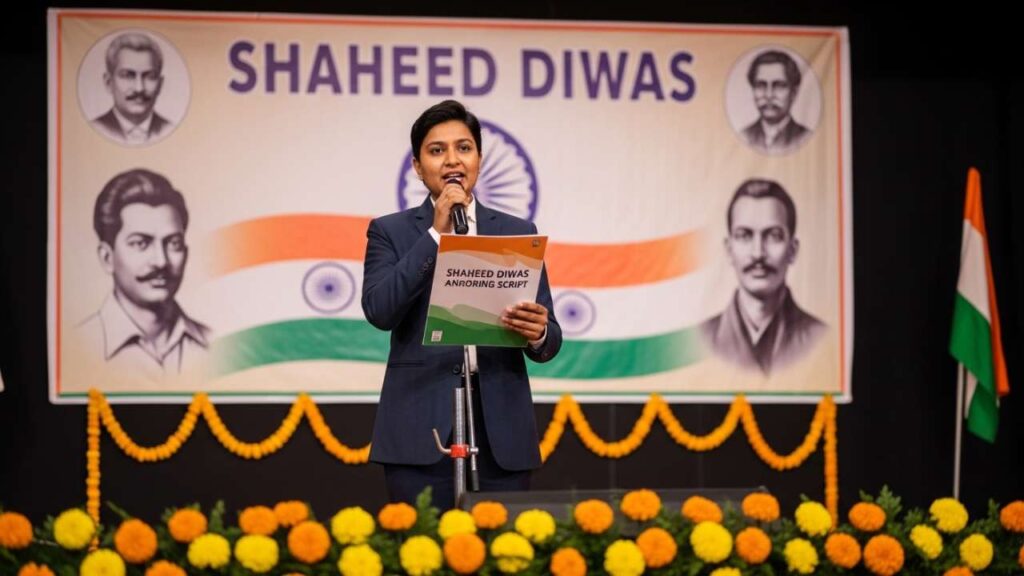
Every year, schools and colleges across India observe March 23 as Shaheed Divas (Martyrs’ Day). On this day in 1931, three of India’s greatest revolutionaries—Bhagat Singh, Sukhdev Thapar, and Rajinath (Rajguru)—were hanged by the British government in Lahore.
If you have been chosen as the anchor for the March 23 assembly, you must understand that this is not a regular morning prayer. It is a day of absolute pride, high energy, and deep respect. The atmosphere should resonate with the echoes of patriotism and sacrifice.
Unlike January 30 (Mahatma Gandhi’s Martyrs’ Day), which emphasizes peace and nonviolence, March 23 highlights the fiery youth and fearless sacrifice. Your voice must reflect that fire, that determination, and that unshakeable spirit.
Below is a complete Shaheed Divas Anchoring Script in English, designed to give your school assembly goosebumps and inspire every student in the audience.
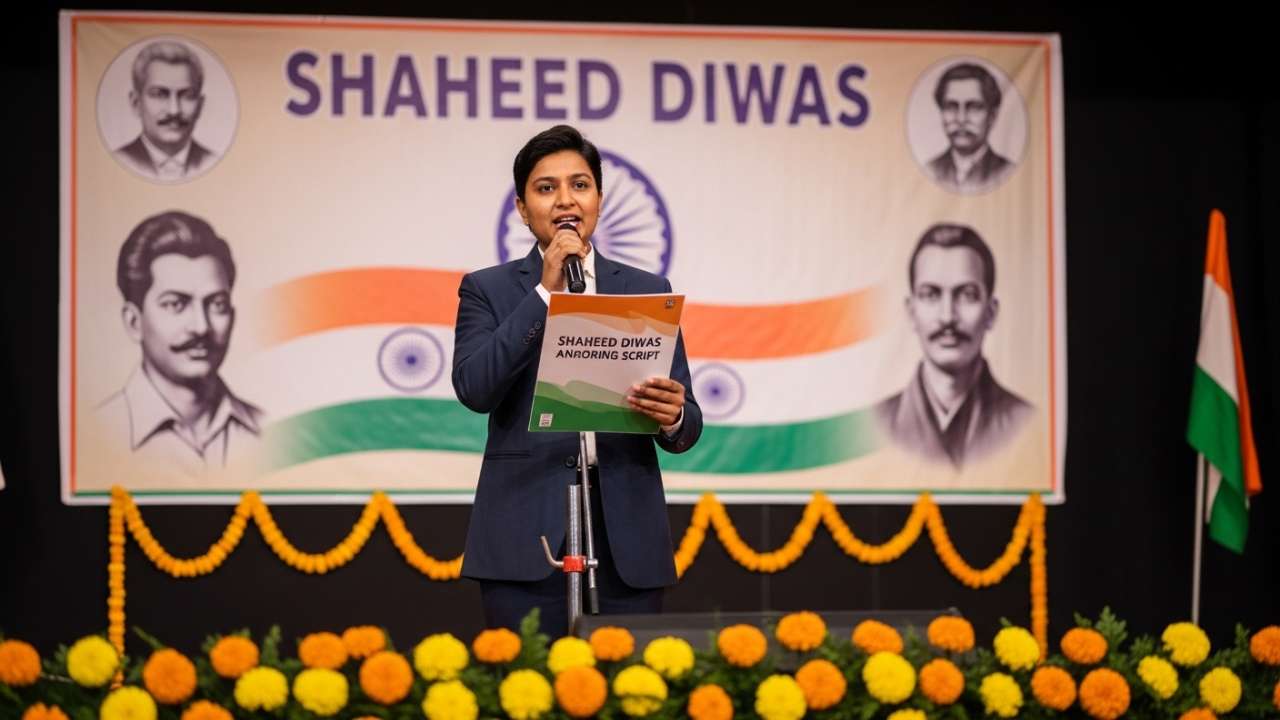
The Script: Shaheed Divas Assembly (23 March)
(Scene: Both anchors walk to the podium with straight, confident posture. Background music plays softly in the background.)
Part 1: The Powerful Entry
ANCHOR 1 (Male): “Good morning to our respected Principal Sir/Madam, esteemed teachers, and my brave friends.”
ANCHOR 2 (Female): “Today is not an ordinary day. Today is the day we remember the brave hearts who gave everything they had for the freedom of our nation.”
ANCHOR 1: “On this day, March 23, 1931, three of India’s greatest freedom fighters were hanged by the British authorities in Lahore. Their names were Bhagat Singh, Sukhdev, and Rajinath.”
ANCHOR 2: “We are gathered here not in sorrow, but in pride and respect. These young revolutionaries chose death over slavery. They chose honor over compromise.”
ANCHOR 1: “Today, we observe Shaheed Divas to mark the martyrdom of these heroes and to keep their legacy alive in our hearts and minds.”
ANCHOR 2 (Voice rising with pride): “Their sacrifice reminds us that freedom is not free. Freedom comes at a price. And that price was paid by these heroes when they were barely in their twenties.”
ANCHOR 1: “So, let us bow our heads and welcome this solemn assembly with reverence and respect.”
Also Read:- Best Labour Day Anchoring Script for School Students – Simple & Powerful Hosting Script
Part 2: Floral Tribute (Pushpanjali)
ANCHOR 1: “To pay our deepest respects to these brave sons of Mother India, I request our Principal Sir/Madam to offer a floral tribute to the portraits of our martyrs.”
(Background Music plays softly: Instrumental of patriotic songs like “Kar Chale Hum Fida” or “Inquilab Zindabad”)
ANCHOR 2: “While the flowers are being offered, let us remember that Bhagat Singh was just 23 years old when he was martyred. Can you imagine? A young student, barely older than many of you sitting here, chose to sacrifice his life for the freedom of our country.”
ANCHOR 1: “Sukhdev was 24, and Rajinath was also in his early twenties. They had their whole lives ahead of them. But they did not hesitate. They did not run. They stood firm in their beliefs.”
ANCHOR 2: “Their courage, their conviction, and their unwavering commitment to the cause of freedom—these are the lessons they have left for us.”
(Flowers are offered. A moment of silence.)
ANCHOR 1: “Thank you, Principal Sir/Madam. Let us now proceed with the next part of our assembly.”
Part 3: Slogan Shouting & Energy Boost
ANCHOR 1: “A tribute to Bhagat Singh is incomplete without his most famous slogan. This slogan became the rallying cry of the freedom movement. When I say the first word, you all will respond with the second word. Are you ready?”
ANCHOR 2: “The slogan is: ‘Inquilab Zindabad’ – which means ‘Long Live the Revolution!'”
ANCHOR 1 (Shouting with energy): “Inquilab!”
ENTIRE ASSEMBLY (In unison): “Zindabad!”
ANCHOR 1: “Inquilab!”
ENTIRE ASSEMBLY: “Zindabad!”
ANCHOR 1: “Inquilab!”
ENTIRE ASSEMBLY: “Zindabad!”
ANCHOR 2: “Jai Hind!”
ENTIRE ASSEMBLY: “Jai Hind!”
ANCHOR 2: “Vande Mataram!”
ENTIRE ASSEMBLY: “Vande Mataram!”
ANCHOR 1 (Loudly): “This is the spirit of Bhagat Singh! This is the fire that burned in the hearts of our freedom fighters! This is what we must carry forward!”
Also Read:- Best Labour Day Anchoring Script for School Students – Simple & Powerful Hosting Script
Part 4: The Speech & Performance
ANCHOR 2: “To shed more light on the life, achievements, and sacrifices of our heroes, I would like to invite [Student Name/Class] to deliver a speech on ‘The Legacy of Bhagat Singh.'”
(Student comes to the podium and delivers a 2-3 minute speech)
[SAMPLE SPEECH CONTENT]:
“Respected teachers and dear friends,
Bhagat Singh was born on September 28, 1907, in Punjab. But his life was not ordinary. From childhood, he was inspired by the freedom movement. He read about revolutions. He studied the works of great political thinkers.
In 1928, he participated in the killing of John Saunders, a British police officer who had brutally beaten Lala Lajpat Rai. In 1929, along with Sukhdev, he threw bombs in the Central Assembly to shock the British government.
He was arrested, tortured, but never broke. He was sentenced to death, but he walked to the gallows with his head held high.
His last words were words of defiance. His last moments were moments of pride.
Today, we remember him not with tears, but with courage. We remember him by striving to be better citizens, by fighting injustice, by standing up for what is right.”
(Student returns to his/her seat)
ANCHOR 1: “Thank you for those powerful words. These words remind us that Bhagat Singh’s fight was not just against the British. It was a fight for justice, equality, and freedom.”
ANCHOR 2: “His ideas still live. His spirit still inspires. His sacrifice still matters.”
Part 5: The 2-Minute Silence
ANCHOR 1: “As is the tradition of our nation, we will now observe a two-minute silence to pay our respects to all our freedom fighters who sacrificed their lives for our independence.”
ANCHOR 2: “This silence is sacred. During these two minutes, we do not speak. We do not move unnecessarily. We simply bow our heads and remember.”
ANCHOR 1: “I request everyone to stand in attention. Let us take a moment to honor their memory.”
(All students and teachers stand up. Silence for exactly 2 minutes. No movement. No sound.)
ANCHOR 2 (Softly, after 2 minutes): “Om Shanti. Om Shanti. Om Shanti.”
ANCHOR 1: “You may be seated.”
Also Read:- Mother’s Day UK Anchoring Script in English for School Assembly | Professional Event Scripts
Part 6: Conclusion & Dismissal
ANCHOR 1: “As we conclude this assembly, I want to leave you with a thought. Bhagat Singh once said: ‘It is the duty of every Indian to drive out the British.’ His work was against the British. But the spirit of his words—that it is the duty of every citizen to fight for what is right—this spirit remains timeless.”
ANCHOR 2: “Today, our freedom is not threatened by foreign rulers. But it is threatened by other things: corruption, injustice, inequality, and ignorance. Bhagat Singh would want us to fight these enemies with the same courage he showed.”
ANCHOR 1: “So, let us take a pledge today. Let us pledge that we will never let their sacrifices go in vain. We will work hard. We will study hard. We will build a strong, just, and prosperous India—the India that these heroes dreamed of.”
ANCHOR 2: “Before we leave, I want to read a few lines that capture the spirit of Bhagat Singh:”
“I am writing these lines to bid goodbye,
To the comrades in the struggle, both near and far.
My life, if given today, will be a small price,
For the freedom of my beloved motherland.”
ANCHOR 1: “We salute you, Bhagat Singh. We salute you, Sukhdev. We salute you, Rajinath.”
ANCHOR 1 & 2 (Together, with conviction):
“Jai Hind! Jai Bharat!”
(National Anthem plays. All students stand and sing.)
Director’s Guide: Stage Management for March 23
To make this script truly effective and to create a memorable assembly, presentation and stage management are crucial. Here are 5 expert tips to ensure your delivery is impactful:
1. Voice Modulation: The “Veer Rasa” (Heroic Emotion)
When you speak lines related to Bhagat Singh and the freedom struggle, your voice should carry the emotion of heroism (Veer Rasa).
- Speak from your chest, not your throat.
- When delivering slogans, project your voice with power and confidence.
- When describing their sacrifices, add a touch of emotion but not sentimentality.
- Look directly into the audience’s eyes. Make eye contact. Own the stage.
- Do not sound sad. Sound proud. Sound inspired.
2. Dress Code: The Basanti (Yellow) Tribute
Bhagat Singh is historically associated with the color yellow due to the famous patriotic song “Mera Rang De Basanti Chola” (My Saffron Robe).
Suggestions:
- Anchors can wear yellow/mustard colored shirts or kurtas or pin a yellow ribbon to their school uniforms.
- Teachers can also wear yellow as a show of respect.
- This visual tribute will be noticed and appreciated by everyone.
3. Timing & Pace of Delivery
- Entry: Walk slowly and deliberately to the podium. This is not a casual walk. This is a march of respect.
- Speech delivery: Speak slowly and clearly. Emphasize important words.
- Slogans: Shout with energy, but not in a chaotic way. Let there be a rhythm.
- The 2-minute silence: This is the most important part. Do not rush it. Make sure you actually time it for 2 full minutes.
4. Audio & Background Music Coordination
Ask your sound team to:
- Play soft instrumental patriotic music during the floral tribute (like “Kar Chale Hum Fida” or “Inquilab Zindabad”)
- Keep volume low so anchors can still speak clearly
- Play the National Anthem at the very end (after “Jai Hind”)
- Use a timer for the 2-minute silence (tell the sound person when to give you a signal)
5. Crowd Management & Energy
- Before the assembly: Brief the students and teachers. Let them know they will need to shout slogans.
- During slogans: Encourage them to participate loudly and enthusiastically. This is not a time to be quiet.
- Visual elements: If possible, have portraits of Bhagat Singh, Sukhdev, and Rajinath displayed prominently on the stage.
- Lighting: If your school has stage lights, use them to highlight the podium during the 2-minute silence.