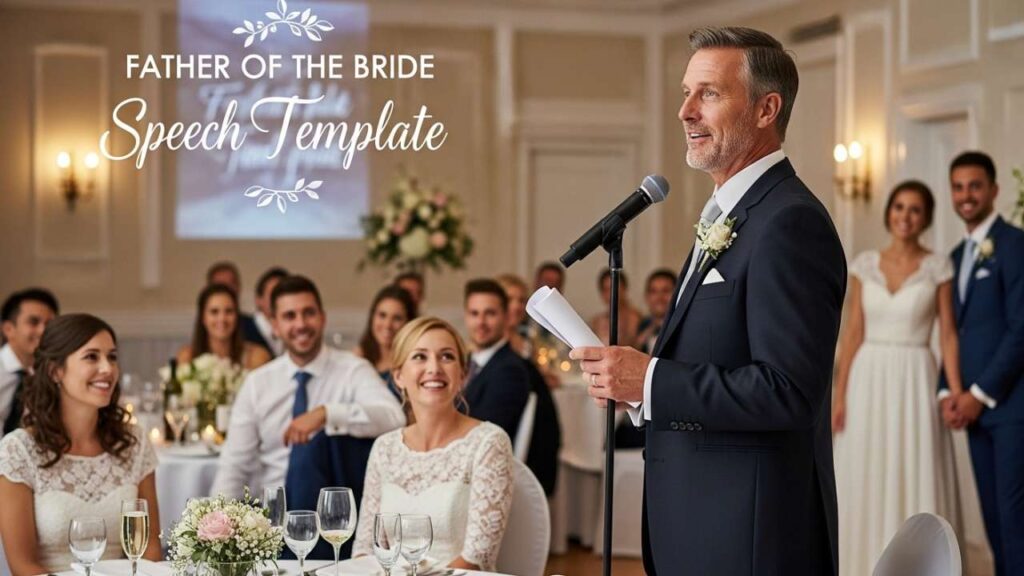
So your little girl is getting married. And somewhere between the venue bookings, the dress fittings, and that awkward conversation with the florist about peonies versus roses — someone handed you a microphone and said, “You’re giving the speech.”
Deep breath. You’ve got this. And this guide is going to make sure of it.
Whether you’ve already written three drafts and thrown them all away, or you’re staring at a blank page two weeks before the big day, this article covers everything — the full speech template, fill-in-the-blank sections, real examples you can actually use, tips to stop your voice from cracking, and answers to every question dads search for at 11pm the night before a wedding.
Why So Many People Search for “Father of the Bride Speech Template”
Before we get into the actual writing part, let’s talk about something interesting — the sheer number of people who search for this topic every single month.
The reason is simple: this speech carries more emotional weight than almost anything else most fathers will ever be asked to do publicly. It’s not just a toast. It’s a goodbye of sorts, a declaration of love, a welcome of a new person into the family, and a performance in front of every person who matters in your daughter’s life — all rolled into about five minutes.
No wonder dads are googling it in a panic.
People search variations like “father of the bride speech template,” “father of the bride speech examples,” “short father of the bride speech,” “funny father of the bride speech,” “father of the bride speech ideas,” “father of the bride toast,” “what to say in a father of the bride speech,” “how long should the father of the bride speech be,” and “father of the bride speech for stepdaughter” — each one representing a different version of the same anxious father sitting at a kitchen table, trying to put into words the thing he’s felt for thirty years.
This guide answers all of those questions in one place.
What Exactly Is a Father of the Bride Speech?
A father of the bride speech is a short address given by the bride’s father (or father figure) during the wedding reception. It typically happens at the beginning of the toasts, making you the very first speaker — which sounds terrifying but is actually an advantage because the crowd is still fresh, well-fed, and genuinely excited to hear from you.
Traditionally, the father of the bride speech does a few specific things: welcomes guests, celebrates the bride, acknowledges the groom (and his family), offers a bit of wisdom or humor, and ends with a toast to the happy couple.
It is not a roast. It is not a TED Talk. It is not your opportunity to revisit every embarrassing story from her childhood. It is a chance to say the things your daughter has probably always known but never quite heard you say out loud.
How Long Should a Father of the Bride Speech Be?
Most wedding planners, speech coaches, and experienced wedding guests will tell you the sweet spot is three to five minutes. That works out to roughly 400 to 700 words when spoken at a comfortable, unhurried pace.
Some dads want to do longer — maybe eight or ten minutes — because they feel like they have so much to say. Resist the urge. Guests begin to drift after five minutes regardless of how charming you are, and a shorter speech that lands every beat is infinitely more powerful than a longer one that meanders.
If you’re a genuinely funny person and your daughter is okay with a more playful tone, you might stretch to six or seven minutes. But if you’re not sure, cut it shorter rather than longer. The guests will thank you, and your daughter will remember the hits, not the runtime.
The Complete Father of the Bride Speech Template (8-Part Structure)
Here is the full template broken into eight clear sections. Every great father of the bride speech contains most, if not all, of these parts. You don’t have to use them in this exact order, but this structure is tried-and-tested for a reason — it flows naturally and covers all the bases guests expect.
Part 1: The Opening (Welcome and Introduction)
This is your icebreaker. You want to grab attention, settle any nerves (yours and theirs), and let people know who you are — even if most of them already know.
Fill-in-the-Blank Version:
“Good evening everyone. For those I haven’t met, my name is [YOUR NAME], and I am the incredibly proud — and admittedly slightly nervous — father of [BRIDE’S NAME]. On behalf of [YOUR PARTNER’S NAME OR YOUR FAMILY], welcome. We are so glad you’re all here.”
If you want to open with a light joke:
“Good evening. I’m [YOUR NAME] — [BRIDE’S NAME]’s dad. I’ve been told I have five minutes for this speech. I’ve also been told I’ve been practicing it for thirty years. Let’s see which version wins.”
Key things to hit in the opening:
- Your name and your relationship to the bride
- A warm welcome to all guests (and any special acknowledgment for those who traveled far)
- Set the tone — heartfelt, humorous, or a blend of both
Part 2: Acknowledge the Day and the Absent
This is an optional but meaningful section where you briefly acknowledge the beauty of the occasion and, if relevant, mention anyone who couldn’t be there — a loved one who passed away, a family member who is unwell, or someone watching from overseas.
Example:
“Before I get into the good stuff, I want to take just a moment to mention [NAME], who we all wish could be here today. She would have absolutely loved seeing [BRIDE’S NAME] in that dress. We feel her with us.”
Keep this brief. A sentence or two is enough. If there is no one to acknowledge, you can skip this section entirely — it’s not compulsory.
Also Read:- School Assembly News Reading Script: Word-for-Word Intro, Transitions & Sign-Off
Part 3: Talking About the Bride (The Heart of Your Speech)
This is the most important section of your entire speech. Spend roughly half your total time here. This is where you tell the room who your daughter is — not just the facts of her life, but the shape of her character. The thing that makes her, her.
Pick one, two, or three stories that paint a picture. Not every funny thing she ever did. Not a timeline of her achievements. One or two vivid moments that capture something true about who she is.
Three ways to structure your stories about her:
By life stage — One story from when she was small, one from her teenage years, one from adulthood. This gives a sense of the journey.
By personality trait — Choose two or three of her defining qualities (her kindness, her stubbornness, her ridiculous laugh, her ability to fix anything) and tell a quick story for each.
By a single, powerful memory — Sometimes one really well-told story is more effective than three okay ones. If there’s a moment that captures everything, lead with that.
Fill-in-the-Blank Prompts to Help You Write This Section:
- “From the moment [BRIDE’S NAME] was born / could talk / could walk, it was obvious she was going to…”
- “She has always been the kind of person who…”
- “I remember one time when she was about [AGE]…”
- “The thing I’ve always admired most about my daughter is…”
- “Watching her grow up, I realized that…”
Example of this section written out:
“[BRIDE’S NAME] has always had this thing where she absolutely refuses to ask for help. When she was nine, she spent an entire Saturday afternoon trying to fix her bike tire herself rather than ask me. She came in at five o’clock, covered in grease, with the tire still flat — but she was grinning because she’d figured out exactly where the problem was. She just ran out of time. That’s her in a nutshell. Patient, determined, and never, ever giving up. I’ve watched that same spirit carry her through every hard thing life has thrown at her, and I have no doubt she’ll bring it to this marriage too.”
Part 4: Talking About the Groom (or Partner)
You don’t need to spend a huge amount of time here, but you must address the person your daughter is marrying. Skipping this entirely is a mistake.
Things you can mention: your first impression of them, the moment you knew they were right for your daughter, a quality you genuinely admire in them, how they treat her, or how they’ve already become part of your family.
Fill-in-the-Blank Version:
“When [BRIDE’S NAME] first brought [GROOM’S NAME] home, I [FIRST IMPRESSION — e.g., ‘immediately liked him’ / ‘pretended to be busy in the garden so I could watch him from a safe distance’]. It didn’t take long to see why she chose him. [ONE QUALITY — e.g., ‘He listens to her. Not just hears her — actually listens.’] [GROOM’S NAME], you have made my daughter genuinely happy, and that is the only thing I’ve ever wanted for her. Welcome to the family — though I suspect you’ve been part of it for a while already.”
If you want to add a little humor here:
“[GROOM’S NAME], I have to admit — when you first came to ask for my blessing, you were so nervous you called me ‘sir’ four times in one sentence. I liked that. It showed respect. And honestly, it showed wisdom.”
Part 5: Welcoming the Groom’s Family
A brief but important gesture. You don’t need to name every person, but acknowledging the groom’s parents and family as your new extended family is a warm and classy move.
Example:
“I’d also like to extend a huge welcome to [GROOM’S NAME]’s family — especially [GROOM’S PARENTS’ NAMES]. You raised a wonderful [man/person], and we are so happy our families are joined today.”
Part 6: Thanks and Acknowledgments
As the de facto host of the reception (even if you’re sharing that role), this is your moment to thank key people. Keep it tight — you can thank the venue, the wedding party, and anyone who helped make the day happen. Don’t thank every single person by name or the speech will feel like an Oscar acceptance.
A simple version:
“I want to say a huge thank you to everyone who helped make today possible. To [NAME], for [SPECIFIC THING — ‘keeping [BRIDE’S NAME] calm when the florist cancelled two weeks out’]. And of course, to [YOUR PARTNER’S NAME] — [BRIDE’S NAME] has your [grace/stubbornness/laugh / eye for detail], and that’s the best gift she could have been given.”
Also Read:- Anchoring Script to Introduce Guests at Events | Word-for-Word Scripts, Templates & Tips (2026)
Part 7: Words of Advice (Optional but Memorable)
This section is optional but when it’s done well, it sticks. A short piece of genuine advice — one or two sentences, not a lecture — lands beautifully at this point in the speech. It works best when it comes from lived experience, not a Pinterest quote.
Some honest advice examples that feel real:
“The only thing I know for certain about marriage is this: the fights that feel massive at 9pm almost always seem smaller by morning. Give it the night.”
“Say sorry quickly. Say ‘I love you’ slowly. Those two things will take you a long way.”
“The person sitting next to you right now — they will not be exactly the same person in five years, or ten. That’s not a warning. That’s the whole beautiful point.”
“Never stop dating each other. Even after kids, work, and a mortgage try their best to get in the way.”
Part 8: The Toast (Your Closing)
End with a clear invitation to raise glasses. This signals the end of your speech, gets the whole room involved, and gives you the perfect exit. Keep this punchy and warm.
Fill-in-the-Blank Toast:
“Ladies and gentlemen, please raise your glasses and join me in toasting the two most important people in this room today. To [BRIDE’S NAME] and [GROOM’S NAME] — may your love be modern enough to survive the times, and old-fashioned enough to last forever. The Bride and Groom.”
Alternative Toasts:
“To my daughter — who has always been more than I deserved — and to [GROOM’S NAME], who clearly feels the same way. To [BRIDE] and [GROOM].”
“Here’s to love, laughter, and living happily ever after. Please raise your glasses — to the happy couple.”
Full Example Speech (Short Version — 3 Minutes)
Here’s what it looks like when the template is assembled into one complete speech:
Good evening, everyone. My name is David, and I’m the very proud, slightly emotional father of the bride. On behalf of my wife Karen and our whole family, welcome — and thank you for being here to celebrate Emily and James.
Before I get into it, I want to mention my mum, Emily’s grandmother, who passed away last year. She would have had the time of her life today. We feel her here.
Now. Emily. My daughter. The kid who, at the age of six, decided she wanted to be an architect — not because she’d seen a building she liked, but because she’d seen one she didn’t like and wanted to do it better. That’s her. She doesn’t just want to do things. She wants to do them properly.
That same stubbornness — and I mean that entirely as a compliment — is what’s made her such an extraordinary woman. She cares deeply, she works hard, and she shows up for the people she loves. Every single time.
James. When Emily brought you home the first time, you spent twenty minutes helping me fix a wonky gate before you even sat down for dinner. You didn’t have to do that. But that’s you, isn’t it? You just help. You just do the thing. I’ve watched you love my daughter with that same quiet, steady care, and I couldn’t ask for more.
To James’s parents, Richard and Susan — thank you for raising him. You clearly did something right.
A quick word of advice to you both: the secret to a long and happy marriage, as far as I can tell, is simply this — always be each other’s best audience. Laugh at each other’s jokes. Cheer at each other’s wins. Be the person who is always, always in the front row.
Ladies and gentlemen, please raise your glasses. To Emily and James — may every day be as beautiful as today, and every year be better than the last. The Bride and Groom.
Frequently Asked Questions
Is it okay to read from notes?
Absolutely. No one expects you to memorise five minutes of speech. Print it out in a large font, use cue cards, or read from your phone. The only thing that matters is that you look up often — make eye contact with your daughter, with the groom, and with the guests. Reading robotically with your eyes glued to the page is the one thing to avoid.
What should I NOT say?
Avoid old boyfriends (even as a joke — it’s rarely as funny as you think). Avoid anything your daughter has specifically asked you not to say. Avoid making the speech too much about yourself. Avoid passive-aggressive comments about the wedding budget, the groom’s family, or anything that might land differently than you intend in front of 150 people. And avoid long lists of thank-yous that turn your speech into a school prize-giving ceremony.
What if I’m the stepfather?
Your role is just as meaningful. Begin by acknowledging your relationship clearly — “I’m Mark, Emily’s stepfather, and I’ve had the genuine privilege of being part of her life for the last twelve years.” Don’t try to substitute for the biological father if he’s present, but don’t diminish your bond either. Speak honestly about what you’ve witnessed, what you admire in her, and what you wish for her future. A stepfather speech, done with warmth and no awkwardness about the label, is often the most moving one in the room.
What if I’m giving the speech solo (no mother of the bride speech)?
Then you carry both perspectives. Don’t try to speak for your ex-partner or former spouse, but you can acknowledge the broader family in your opening — “on behalf of Emily’s whole family” — which covers it without getting complicated.
How many times should I practice?
At least five to eight times out loud. Not in your head — out loud. Read it standing up, the way you’ll deliver it. Time yourself. Record yourself on your phone and listen back. Painful, yes. Useful, absolutely. You will hear things you want to change, and you’ll go in on the day feeling a hundred times more confident.
Can I cry?
Yes. In fact, a brief moment of genuine emotion is one of the most powerful things that can happen in a wedding speech. Nobody minds a dad tearing up. What they mind is a speech that drags on so long they stop feeling anything at all. Keep it short, keep it personal, and let the emotion come if it comes. It usually makes the room love you for it.
Final Thought
Your daughter doesn’t need you to be a professional speechwriter. She doesn’t need you to have the crowd roaring with laughter or weeping into their napkins. She needs you to show up, look her in the eye at some point during that speech, and let her know — in front of every person who loves her — that she is everything you hoped she would be.
The template is just scaffolding. What you build inside it is entirely yours.
Start writing. You already know what to say. You’ve known it for years.