“We don’t inherit the Earth from our ancestors; we borrow it from our children.”
On April 22, 2026, over 2 billion people across the globe will unite for World Earth Day. For schools, this isn’t just another date—it’s a call to action, a moment of reckoning, and an opportunity to inspire genuine change.
Most school assemblies fail because they rely on preachy monologues about pollution. This guide provides everything you need to create an unforgettable, engaging, and impactful Earth Day assembly that students will actually remember and act upon.
The Real Story of Earth Day
Before you step on stage, know the truth behind this global movement.
The Real Origin: Earth Day wasn’t born from government goodwill. It was born from rage. In 1969, an oil platform exploded off Santa Barbara, California, spilling 3.5 million gallons of crude oil. Senator Gaylord Nelson watched the disaster in horror and realized Americans needed to care about their planet before it was too late.
On April 22, 1970, the first Earth Day mobilized 20 million Americans across the nation—a peaceful protest that created enough political pressure to establish the Environmental Protection Agency (EPA) in the same year.
Why April 22? Nelson chose the date deliberately—between Spring Break and Final Exams, a window when students could participate. Smart strategy, right?
2026 Theme: “Restoring Our Roots” This year focuses on ecosystem restoration, soil regeneration, and reforestation. It’s not about feeling guilty; it’s about getting your hands dirty and planting seeds (both literally and figuratively).

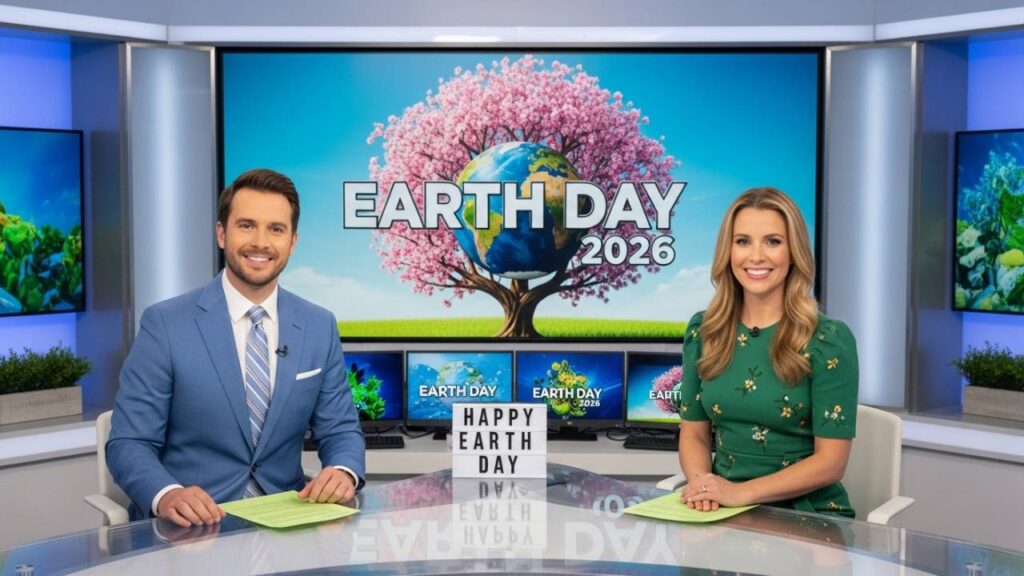
Complete Anchoring Script (Two Hosts)
(Scene: Two confident anchors in eco-friendly attire—perhaps green stoles made from recycled fabric. The stage is decorated with potted plants and student-made environmental art.)
OPENING: The Wake-Up Call
ANCHOR 1: [Walking to center stage with purpose] “Good morning to our Respected Principal, Honorable Guests, Teachers, and my incredible fellow Earthlings!”
ANCHOR 2: [Laughing] “Earthlings? Are we accepting alien citizenship applications now?”
ANCHOR 1: [Grinning] “Well, if we keep treating our planet like a dumping ground, we might actually need to find a new home! So, let’s start caring before we have to apply for visas in space.”
ANCHOR 2: “Smart point. Today is April 22, 2026—World Earth Day. And it’s not about guilt-tripping anyone. It’s about waking up to what’s real.”
ANCHOR 1: “Every year, scientists report the same thing: oceans are warming, forests are shrinking, and species are disappearing. But here’s the difference this year—we’re not just talking about the problem. We’re talking about solutions.”
ANCHOR 2: “Before we begin, let’s respectfully bow our heads for our school prayer.”
[School prayer performed]
PART 2: Setting the Stage
ANCHOR 1: “So what makes 2026 different? The theme this year is ‘Restoring Our Roots’— and yes, that’s both literal and symbolic.”
ANCHOR 2: “Literal because we’re planting trees. Symbolic because we need to reconnect with nature—the roots of human civilization. For centuries, we lived with nature, not against it.”
ANCHOR 1: “Did you know? A single mature tree absorbs 48 pounds of carbon dioxide annually and produces the oxygen for two people. Yet, we’re cutting them down at a rate of 10 billion trees per year globally.”
ANCHOR 2: “That’s the problem. But here’s what’s possible: If every person in this assembly plants just one tree, in 20 years, those trees will have absorbed thousands of tons of CO2. That’s power.”
ANCHOR 1: “Let’s bring it closer to home. Our school has committed to becoming Carbon Neutral by 2027. That means zero net greenhouse gas emissions. Here’s how we’re doing it:”
ANCHOR 2: [Displaying points on screen or reading from cards]
- Converting to 100% renewable solar energy by December 2026
- Eliminating single-use plastics in the cafeteria (already 40% reduction!)
- Planting 500 saplings in and around campus
- Starting a classroom rainwater harvesting system
ANCHOR 1: “And here’s the best part: You are the agents of this change. Not politicians. Not corporations. You.”
PART 3: Introducing Special Segments
ANCHOR 2: “Before we hear from our Chief Guest, we have prepared something special. Our Drama Club is presenting a powerful piece called ‘Dharti Ki Pukaar’—The Earth’s Cry.’”
ANCHOR 1: “This isn’t your typical school play. It’s a reality check delivered in 5 minutes. Please welcome them to the stage.”
Also Read:- Retirement Speech for a Coworker Anchoring Script
Interactive Segment: Earth Day Debate
(This is your unique edge—most schools don’t do this!)
After the play, pause for engagement:
ANCHOR 1: “We just heard the Earth’s plea. Now let’s hear your voice. Quick question for the audience: Who is responsible for climate change?”
[Take 3-4 hands]
- Student 1: “Factories and big companies”
- Student 2: “Governments for not making laws”
- Student 3: “We are, through our daily choices”
ANCHOR 2: “All correct. And here’s the truth: It’s all of us and none of us. Climate change isn’t one person’s fault—it’s a systemic issue. But it can also be fixed by systemic change starting with us.”
ANCHOR 1: “So instead of playing the blame game, let’s ask: What will you do differently today than you did yesterday?”
[Allow 1-2 minutes of student responses — genuine, unscripted answers are gold]
Nukkad Natak Script (Street Play)
Title: “Dharti Ki Pukaar” (The Earth’s Cry)
Cast: Mother Earth, Two Teenagers, Future Child, Businessman
*[Scene: Mother Earth lies on the ground, looking exhausted. A teenage boy and girl are scrolling through their phones, completely oblivious.]
EARTH [Weak voice]: “Can anyone hear me? I’m dying slowly…”
TEEN BOY [Not looking up]: “Dude, did you see how many likes my #SaveEarth post got? 5,000! I’m basically an environmental activist now.”
TEEN GIRL: “Bro, you took that selfie in front of a coal plant. That’s not activism; that’s performance.”
EARTH: “Hello? I just lost another forest the size of your country…”
BUSINESSMAN [Entering with briefcase]: “Forest? We need that space for a shopping mall! Progress, baby!”
EARTH: “Progress toward what? Your grave?”
TEEN BOY: “Earth, chill. We planted a tree sapling last month. One tree. That should be enough, right?”
EARTH: “You cut down 15,000 trees in that same month. You planted one. Do the math.”
[Lights dim. FUTURE CHILD enters, age 8, looking at a barren, brown landscape.]
FUTURE CHILD: [Crying] “Mom, what are oceans? What are forests? I’ve only read about them in history books… Are they real?”
TEEN GIRL [Suddenly seeing the child, shocked]: “Wait—who are you?”
FUTURE CHILD: “I’m your daughter… in 2050. I came back to see what you left for me. Is this it?”
[Long pause. The Earth, Businessman, and Teenagers all look at the child in silence.]
BUSINESSMAN [Suddenly human]: “I didn’t realize…”
EARTH [Standing up, with energy]: “You know what’s funny? You don’t need my permission to save me. You need my participation. Every single one of you has the power to reverse this.”
FUTURE CHILD: “Even now?”
EARTH: “Especially now. You’re not too late. You’re just on time.”
ALL [Together, looking at audience]: “What will you choose? Your comfort today, or their survival tomorrow?”
[Lights fade.]
The Green Pledge Ceremony
(Invite all students to stand)
ANCHOR 1: “Now, we move from words to action. Our School Captain will lead us in the Green Pledge 2026. This is not just a promise to the Earth—it’s a promise to yourself and to your future children.”
[School Captain steps forward]
SCHOOL CAPTAIN: “I pledge to the Earth and to my future generation that I will:”
ALL STUDENTS [In unison]:
- Reject single-use plastic—I will carry a reusable bottle, bag, and lunch container.
- Conserve energy—I will turn off lights, fans, and water when not in use.
- Grow green—I will plant at least two trees this year and maintain them.
- Segregate waste properly—I will separate dry, wet, and hazardous waste at home.
- Speak up—If I see environmental harm, I will report it and suggest solutions.
- Inspire others—I will teach my family and friends to make sustainable choices.
- Choose life—I will never harm animals or plants unnecessarily, and I will protect biodiversity.
ANCHOR 2: “You’ve made this pledge. Now, here’s the accountability: Each class will receive a Green Scorecard. Every week, your teachers will rate your progress on these pledges. The class with the highest score by June will receive the Green Champion Award and a special tree-planting ceremony in your name.”
Also Read:- First Day of School Assembly Script 2026: Complete Anchoring Guide for Teachers & Students
Assembly Organization Ideas
To make your assembly stand out and actually make an impact:
1. The “Carbon Footprint Booth.”
Set up a simple quiz station before the assembly begins where students calculate their weekly carbon footprint (5 questions, takes 2 minutes). Collect this data and announce it during the assembly: “Did you know the average student in this school produces 2.5 kg of CO2 per week? By making 3 small changes, we can reduce that by 40%.”
2. Zero-Waste Assembly Protocol
- Use digital posters instead of printed flexes
- Serve water in glass cups or bottles (not disposable)
- Ask students to bring their own water bottles
- Use handmade, student-created signage (on recycled paper)
- Distribute seeds as “Earth Day favors” instead of plastic trinkets
3. The “Before & After” Visual
Display two photos:
- Before: A local area from 10 years ago (lush, green)
- After: The same area today (deforested, polluted) Let students know: “This is what we’ve lost. Imagine what we can restore.”
4. Live Planting Ceremony
After the assembly, invite all students to plant a sapling together in the school grounds. Make it ceremonial and celebratory—take a group photo with the plants.
5. Environmental Documentary Clip
Play a 3-minute clip from a documentary like Our Planet, Blue Planet, or The Last Oasis. Powerful visuals speak louder than words.
Powerful Slogans & Quotes
English Slogans
- “Every plastic bottle will outlive you—make it count.”
- “Green is not a color; it’s a responsibility.”
- “Think green, act green, live green.”
- “Earth Day is every day—choose wisely.”
- “Save the planet, save ourselves.”
Hindi Slogans
- “Ped lagao aaj, kal lagega fal” (Plant today, harvest tomorrow)
- “Prakriti ka dhyan rakhenge, apna Bharat bachayenge” (Care for nature, save our India)
- “Plasitc ka ek tukda, Prithvi ke liye ek zakhm” (One plastic piece, one wound to Earth)
- “Dharti Maa ke liye karenge kaam, vinaas ke raste se bachayenge swayam” (Work for Mother Earth, save ourselves from destruction)
- “Har ek ped, har ek pani—ye sakhiyaan hain apni” (Each tree, each drop of water—these are our companions)
Powerful Quotes
- Greta Thunberg: “No one is too small to make a difference.”
- Jane Goodall: “What you do makes a difference, and you have to decide what kind of difference you want to make.”
- Bill Nye: “Science rules—and so does our responsibility to the planet.”
- Mahatma Gandhi: “Earth provides enough for every person’s need, but not for every person’s greed.”
FAQs & Pro Tips
Q1: What if our school doesn’t have an environmental budget?
A: Use what you have. Student-made decorations, borrowed equipment, and free digital tools are often more creative and meaningful than expensive setups. Authenticity beats budget.
Q2: How do I keep students engaged during a long assembly?
A: Break it into segments. Never speak longer than 2-3 minutes before introducing something new—a video, a play, a student voice, a question. Variety is your best friend.
Q3: Should we include a “doom and gloom” section?
A: Be realistic but not devastating. Yes, share facts about climate change. But always balance with solutions and hope. Students need to feel empowered, not helpless.
Q4: Can we make Earth Day relevant to non-science subjects?
A: Absolutely. History (Earth Day history), Language (environmental poetry), Economics (cost of pollution), and even Math (carbon calculations) all connect. It’s interdisciplinary.
Q5: How do we ensure the pledges aren’t just empty promises?
A: Accountability. Keep the Green Scorecards, track progress, celebrate wins publicly. Make it visible and ongoing, not a one-day event.
Pro Tips for Perfect Anchoring
Tip 1: Master the Pause
Don’t rush through facts. After stating something impactful, pause for 3 seconds. Let it sink in.
Example: “10 billion trees are cut down every year.” [Pause] “That’s the entire population of this planet, multiplied by one.” [Pause] “What if we reversed that number?”
Tip 2: Use “We”, not “They”
“Factories are polluting our air.” “We rely on factories for clothes and food, but we can push them to pollute less.”
This shifts responsibility from blame to shared action.
Tip 3: Storytelling Over Statistics
Numbers matter, but stories stick. Instead of “27% of oxygen comes from oceans,” say: “Every second breath you take comes from the ocean. And we’re choking it with plastic.”
Tip 4: Invite Real Participation
Don’t just tell students what to do. Ask them. “How many of you have a kitchen garden? How many have reduced plastic at home? How many teach your parents about recycling?”
Celebrate the ones with their hands up. Make sustainability cool.
Tip 5: End with Hope, Not Helplessness
Your final line should be memorable and motivating.
Option 1: “Today, we don’t just celebrate Earth Day. We become the generation that saved it.”
Option 2: “The best time to plant a tree was 20 years ago. The second-best time is today. Let’s begin.”
Option 3: “Future generations will judge us by one question: Did you know? Yes. Did you care? Yes. Did you act? Let’s make sure the answer is yes.”
Also Read:- Holi 2026 Vastu Tips: 5 Things You Must Remove Before Holi to Invite Prosperity and Positive Energy
Conclusion
Earth Day 2026 is your moment to lead. Not as students following a script, but as agents of change who understand the stakes and choose action.
The Earth doesn’t need your pity. It needs your participation. It doesn’t need a day of remembrance; it needs a lifetime of care.
Start today. Start now. Start with one tree, one plastic-free lunch, one conversation that changes a mind.
Because in 2050, when future generations ask you, “What did you do on Earth Day 2026?”—you’ll have a real answer, not an apology.