
An annual function is not just an event — it is the single most public showcase of a school or college’s spirit, talent, and culture. Parents, guests, faculty, and students are all watching. In that moment, the anchor is the thread that holds the entire evening together. A stumbling, unprepared host can make even the best performances feel disjointed. A confident, well-scripted one can make an ordinary program feel extraordinary.
Yet, despite how critical the role is, most students who are asked to anchor an annual function are handed a rough running order and told to “just speak naturally.” The result is awkward silences, mispronounced chief guest names, and transitions that kill the room’s energy. A proper anchoring script for annual function solves all of that before the curtain even rises.
A written script gives you three concrete advantages. First, it eliminates blanks — you always know what to say next, even when your nerves are firing. Second, it allows you to rehearse tone and pacing, so the energy in the hall stays high throughout. Third, it builds credibility: polished language signals professionalism to parents and guests and earns immediate respect from the audience.
The script below is structured for a standard school or college annual function running between 90 and 150 minutes. It covers five essential segments: the welcome address, introduction of distinguished guests, cultural performances, prize distribution, and the vote of thanks. Simply customize names, event titles, and school details before you go on stage.
Complete Anchoring Script for Annual Function
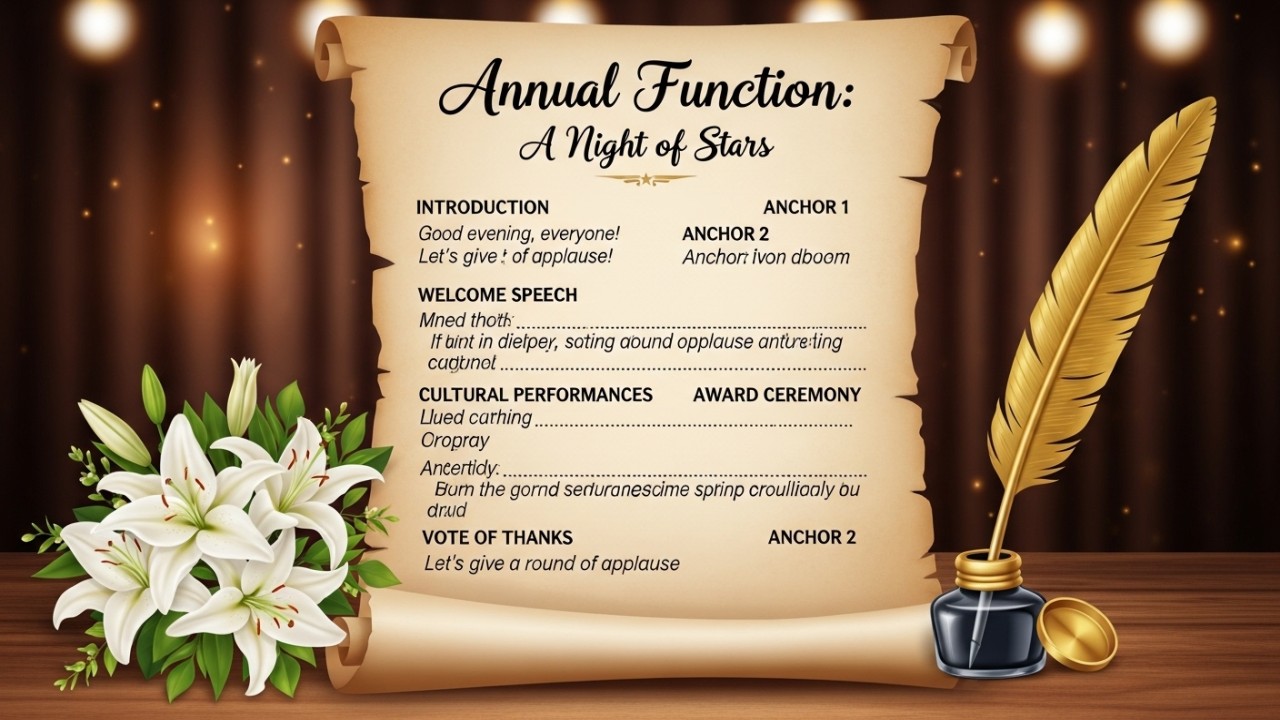
The script below is written for two anchors — Anchor A and Anchor B — which is the most common setup for school and college events. If you are anchoring alone, simply read both parts continuously and adjust the language where needed.
Also Read:- Best Pulwama Attack Black Day Speech for School Students (February 14, 2026) — Full Script + Guide
Part 1: Opening and Welcome Address
ANCHOR A: Good evening, ladies and gentlemen. A very warm welcome to each and every one of you. Tonight, we gather not just to celebrate an occasion — we gather to celebrate us. The students, the teachers, the parents, and the dreamers who make this institution what it is.
ANCHOR B: I am [Your Name], and I am [Your Name], and together we have the immense honour and privilege of hosting the Annual Function of [School/College Name] — the [Year] edition. Tonight promises to be an evening of talent, joy, inspiration, and celebration.
ANCHOR A: Before we begin the festivities, let us take a moment to acknowledge those who have graced us with their presence this evening. We are truly humbled and delighted to welcome our Chief Guest, [Chief Guest’s Full Name and Designation], whose remarkable journey has inspired thousands. Sir/Ma’am, your presence honours us greatly.
ANCHOR B: We also extend our heartfelt welcome to our respected Principal, [Principal’s Name], the guiding force behind everything that makes this institution extraordinary. Our warmest welcome goes to our esteemed faculty members, the dedicated support staff, our wonderful parents, and of course — the beating heart of this event — our talented students.
ANCHOR A: We request our respected Principal, [Principal’s Name], to please grace the stage and share a few words with us.
(Pause for applause. Step to the side. After the speech, return to centre stage.)
ANCHOR B: Thank you so much, [Principal’s Name] Sir/Ma’am — truly an inspiration, as always. And now, let us invite our Chief Guest, [Chief Guest Name], to formally inaugurate the [Year] Annual Function by lighting the ceremonial lamp.
(Lamp-lighting ceremony takes place. Wait for applause to settle.)
Also Read:- Best Anchoring Script for Any Event (Complete Guide 2025)
Part 2: Introducing Cultural Performances
ANCHOR A: And with the lamp now lit — let the celebrations begin! Our students have worked tirelessly for months to bring tonight’s performances to life, and we cannot wait for you to witness their brilliance.
ANCHOR B: Our first performance is a classical dance presentation titled “[Performance Name],” beautifully choreographed by [Teacher/Student Name]. Please put your hands together and welcome the performers to the stage!
(Step back and wait for performers to take position before exiting to the side.)
ANCHOR A: (After the performance ends and applause dies down) Weren’t they absolutely breathtaking? Each movement told a story, and each story filled this hall with life. Let us give them another big round of applause.
ANCHOR B: If dance speaks through movement, music speaks through the soul. Our next performance is a soulful musical rendition of “[Song/Composition Title]” by [Performer Name or Group Name]. Please welcome them to the stage.
(Repeat this transition pattern for each subsequent performance, varying the opening line so the energy stays fresh.)
ANCHOR A: We will now have a brief intermission of [X] minutes. Please feel free to visit the refreshment counters and rejoin us as we continue with more wonderful surprises. We will be back shortly!
(Skip this block entirely if your event has no intermission.)
Part 3: Prize Distribution Ceremony
ANCHOR B: And now we arrive at a segment that many of us have been waiting for — the Prize Distribution Ceremony. Tonight, we celebrate achievement. We celebrate the hours of silent preparation, the quiet sacrifices, and the burning desire to be better.
ANCHOR A: We request our Chief Guest, [Chief Guest Name], and our Principal, [Principal Name], to kindly take their seats on the dais for the prize distribution. Ladies and gentlemen, please hold your applause until each category has been announced.
ANCHOR B: We will now begin with the Academic Excellence Awards. Could the following students please come forward to receive their awards when their names are called?
(Read names clearly, one at a time. Pause after each name for the student to walk up to the stage.)
ANCHOR A: (After each category) Congratulations to all our awardees in this category. Your achievement is a testament not only to your talent, but to your discipline and your will. Let us celebrate them with a warm round of applause.
ANCHOR B: (After all prizes are distributed) What a remarkable group of achievers. This institution is proud of each and every one of you — and to those who did not receive an award today: your time is coming. Keep going.
Part 4: Chief Guest’s Address
ANCHOR A: We now have the most anticipated moment of the evening — the address by our distinguished Chief Guest, [Chief Guest Name and Designation]. [He/She/They] has [brief one-sentence introduction — for example, “dedicated over two decades to transforming education across the country”]. We consider ourselves truly fortunate to have [him/her/them] with us tonight.
ANCHOR B: Respected Sir/Ma’am, the stage is yours. Ladies and gentlemen, a warm round of applause, please.
(Stand at the side of the stage during the speech. Return to centre after the speech concludes.)
ANCHOR A: (After the speech) Thank you so much, [Chief Guest Name] Sir/Ma’am, for those truly motivating and insightful words. We are certain that every student here will carry those words with them long after tonight.
Also Read:- February 14 Black Day: Remembering the Pulwama Attack — India’s Darkest Valentine’s Day
Part 5: Vote of Thanks and Closing
ANCHOR B: As we draw near to the close of this wonderful evening, it is time to express our deepest gratitude to the many people who made tonight possible.
ANCHOR A: We are profoundly grateful to our Chief Guest, [Name], for generously giving their time and wisdom to our students. Your presence has made this evening truly special.
ANCHOR B: Our heartfelt thanks go to our respected Principal, [Name], and to the entire teaching faculty whose unwavering dedication shapes these young minds each and every day. Thank you for believing in us, even when we did not believe in ourselves.
ANCHOR A: We extend a special note of thanks to the organizing committee, the technical team, the backstage crew, and every single student who spent countless hours rehearsing. You are the reason tonight was magic.
ANCHOR B: And to our wonderful parents and guardians — thank you for being here, for your support, and for trusting this institution with your most precious gifts.
BOTH ANCHORS (together): On behalf of [School/College Name], we wish everyone a safe and happy journey home. Thank you for being a part of our Annual Function [Year]. Good night!
(Bow together. Smile. Exit the stage only after the national anthem or official close, as per your school’s protocol.)
Stage Confidence Tips for Anchors
Even the best script cannot fully compensate for nerves that seize your body the moment you step into the spotlight. Stage confidence is a skill, and like every skill, it can be learned and practiced before the big day.
Tip 1 — Practice out loud, not in your head. Silent reading fools you into thinking you know the script. Speaking it aloud, especially in front of a mirror or a friend, exposes every stumble before the audience does.
Tip 2 — Slow down by 20%. Nerves accelerate everything. If you feel like you are speaking slowly on stage, you are probably speaking at exactly the right pace. Deliberate pauses feel like power, not hesitation.
Tip 3 — Make eye contact in zones. You do not need to look at every face. Divide the hall into three sections — left, centre, right — and rotate your gaze naturally so every part of the audience feels included.
Tip 4 — Rehearse the worst case. What if you forget your line? What if the mic cuts out? Rehearse these scenarios so that when they happen, you respond calmly rather than panic visibly.
Tip 5 — Confirm every name in advance. Mispronouncing the chief guest’s name or getting a student’s award wrong is embarrassing and entirely avoidable. Collect a written list from the event coordinator and practise each name at least five times.
Tip 6 — Carry a printed script backup. Even if you know the script cold, hold a neatly printed copy at your side. It signals preparation and gives you something to glance at without appearing lost if you draw a blank.
Frequently Asked Questions
Q. How long should an anchoring script for an annual function be? For a standard 90–150 minute annual function, your total anchoring time — excluding performances and speeches — will be approximately 15 to 20 minutes. Each transition should take 30 to 90 seconds, and the opening and closing segments can run 2 to 3 minutes each. Keep transitions crisp, as audiences lose attention when anchors over-explain what is about to happen.
Q. What if I am anchoring alone instead of with a co-anchor? Solo anchoring works perfectly well. Simply merge the two anchor parts and read them in sequence. Add slightly longer transitions to give yourself time to move positions on stage and to give performers a moment to set up. Vary your tone and energy between segments to prevent monotony.
Q. How do I handle an unexpected delay or technical issue on stage? Stay calm and fill gracefully. You can say: “While our team makes sure everything is perfect for the next performance, let me share a quick thought…” Then speak briefly about a theme of the event — perseverance, creativity, teamwork — for 60 to 90 seconds. Audiences forgive delays; they do not forgive a flustered anchor who makes the delay feel bigger than it is.
Q. Should I memorise the script or read from a paper? The ideal approach is what professional anchors call prepared spontaneity — you have internalized the content well enough to speak naturally, but you hold the script as a safety net. Avoid reading with your head down, as your face and expression are as important as your words. Highlight key phrases so your eye can find its place instantly after a glance.
Q. What are the most common mistakes first-time anchors make? The five most common mistakes are rushing through transitions without pausing for applause to settle, not confirming the correct pronunciation of guest names beforehand, using the same opening line for every performance, starting the vote of thanks too abruptly, and forgetting to face the audience when reading from a script. All of these are easily corrected with a single full rehearsal on the actual stage.
Q. Can I add humour to the anchoring script? Yes — light, inclusive humour can lift the atmosphere considerably. Stick to self-deprecating jokes about your own nervousness, or gentle observations about school life that everyone can relate to. Avoid jokes about specific individuals or groups, and always read the room. When in doubt, a warm smile and genuine enthusiasm are more effective than any joke.