
Graduation marks one of life’s most pivotal moments—a bridge between who you were and who you’re becoming. At the heart of every memorable graduation ceremony is a powerful speech that captures the essence of this transformation. Whether you’re delivering a valedictorian address, writing your first commencement speech, or simply seeking inspiration from famous graduation speeches, this comprehensive guide will equip you with everything you need to create and deliver words that resonate for a lifetime.
What Makes a Great Graduation Speech?
A truly exceptional graduation speech does more than fill time at a ceremony—it creates a lasting emotional connection with the audience. The best graduation speeches balance three critical elements: reflection on shared experiences, celebration of current achievements, and inspiration for future endeavors.
Great commencement speeches aren’t about the speaker; they’re about the collective journey of the graduating class. They acknowledge the struggles overcome, the friendships forged, and the growth that happened along the way. Most importantly, they leave graduates feeling empowered, hopeful, and ready to take on whatever comes next.
Research shows that people rarely remember specific words from graduation speeches, but they always remember how those words made them feel. The most impactful speeches tap into universal emotions while remaining authentic to the speaker’s unique voice and perspective.
Key Elements of Memorable Graduation Speeches
| Element | Description | Why It Matters |
|---|---|---|
| Authenticity | Speaking from genuine experience and emotion | Audiences connect with real stories, not rehearsed platitudes |
| Relatability | Shared experiences and collective memories | Makes graduates feel seen and understood |
| Inspiration | Forward-looking hope and encouragement | Sends graduates into the future with confidence |
| Brevity | Concise delivery (5-10 minutes) | Respects audience attention and maximizes impact |
| Emotion | Balance of humor, gratitude, and wisdom | Creates memorable emotional moments |
| Specificity | Concrete examples and stories | Specific details resonate more than abstract advice |
12 Famous Graduation Speeches That Changed Lives
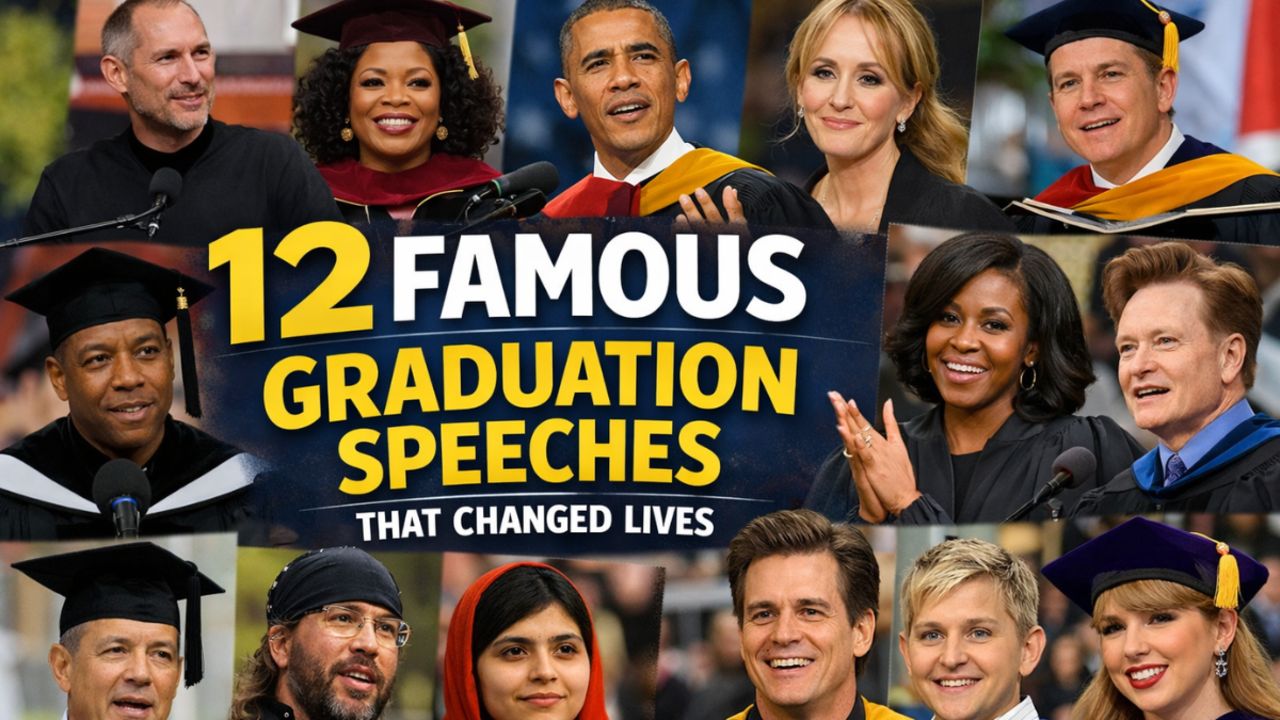
1. Steve Jobs at Stanford University (2005): “Stay Hungry, Stay Foolish”
Perhaps the most watched commencement speech of all time with nearly 40 million YouTube views, Steve Jobs’ Stanford address remains a masterclass in storytelling and inspiration. Despite never graduating from college himself, Jobs delivered three personal stories about connecting the dots, love and loss, and death.
Key Quote: “Your time is limited, so don’t waste it living someone else’s life. Don’t be trapped by dogma—which is living with the results of other people’s thinking. Don’t let the noise of others’ opinions drown out your own inner voice.”
Why It Works: Jobs avoided platitudes and instead shared vulnerable, authentic stories from his own life, including being fired from Apple and facing his mortality. His message about following your intuition and loving what you do resonated because it came from genuine experience, not abstract advice.
2. Oprah Winfrey at Harvard University (2013): “Failure Is Life’s Redirection”
Oprah Winfrey’s Harvard commencement speech tackled one of the most difficult topics: failure. She reframed setbacks not as endings but as life’s way of pushing us in a better direction.
Key Quote: “There is no such thing as failure. Failure is just life trying to move us in another direction. The key to life is to develop an internal moral, emotional GPS that can tell you which way to go.”
Why It Works: Oprah spoke from a place of hard-won wisdom, sharing her own professional setbacks and how they led to greater opportunities. Her emphasis on trusting your internal guidance system gave graduates permission to forge their own unique paths.
3. J.K. Rowling at Harvard University (2008): “The Fringe Benefits of Failure”
Before she became one of the world’s best-selling authors, J.K. Rowling experienced rock bottom. Her Harvard commencement speech, titled “The Fringe Benefits of Failure and the Importance of Imagination,” shared her journey from joblessness and poverty to literary success.
Key Quote: “It is impossible to live without failing at something, unless you live so cautiously that you might as well not have lived at all—in which case, you fail by default.”
Why It Works: Rowling normalized failure as an inevitable and even beneficial part of life. Her honest account of her darkest period made success feel achievable even after setbacks.
4. Denzel Washington at University of Pennsylvania (2011): “Give Everything You’ve Got”
Actor Denzel Washington delivered a powerful call to action about service, generosity, and legacy at the University of Pennsylvania.
Key Quote: “The world needs a lot—and we need it from you, the young people. So get out there. Give it everything you’ve got—whether it’s your time, your talent, your prayers, or your treasure. Because remember this: You’ll never see a U-haul behind a hearse.”
Why It Works: Washington’s speech reminded graduates that true success isn’t measured by accumulation but by contribution. His memorable closing line about not being able to take material possessions with you became instantly quotable.
5. Conan O’Brien at Dartmouth College (2011): “Disappointment Will Come”
Comedian Conan O’Brien brought his signature humor to Dartmouth while addressing the serious topic of career setbacks, drawing from his highly publicized Tonight Show controversy.
Key Quote: “Today I tell you that whether you fear it or not, disappointment will come. The beauty is that through disappointment you can gain clarity, and with clarity comes conviction and true originality.”
Why It Works: O’Brien proved that humor and wisdom aren’t mutually exclusive. His ability to laugh at his own professional disasters while extracting meaningful lessons made the speech both entertaining and profound.
6. David Foster Wallace at Kenyon College (2005): “This Is Water”
Acclaimed author David Foster Wallace delivered one of the most intellectually challenging and philosophically rich commencement speeches ever given, later published as “This Is Water.”
Key Quote: “The real value of a real education has almost nothing to do with knowledge, and everything to do with simple awareness—awareness of what is so real and essential, so hidden in plain sight all around us, that we have to keep reminding ourselves over and over: ‘This is water.'”
Why It Works: Wallace challenged graduates to consciously choose how they construct meaning from experience, advocating for awareness, empathy, and intentional living in mundane daily life.
7. Chimamanda Ngozi Adichie at Wellesley College (2015): “Be a Full Person”
Nigerian author Chimamanda Ngozi Adichie encouraged graduates to embrace their complete selves without twisting into shapes to please others.
Key Quote: “Do not twist yourself into shapes to please. Don’t do it. If someone likes that version of you, that version of you that is false and holds back, then they actually just like that twisted shape, and not you.”
Why It Works: Adichie’s speech was a powerful call for authenticity, particularly resonant for women facing societal pressures to conform. She validated the courage it takes to exist fully in the world.
8. Kerry Washington at George Washington University (2013): “Write Your Own Story”
Actress Kerry Washington drew parallels between performance and life, encouraging graduates to author their own narratives rather than following someone else’s script.
Key Quote: “When you leave here today and commence the next stage of your life, you can follow someone else’s script, try to make choices that will make other people happy, avoid discomfort, do what is expected and copy the status quo or you can look at all that you have accomplished today and use it as fuel to venture forth and write your own story.”
Why It Works: Washington acknowledged that the path of authenticity requires courage but promised that “amazing things will take shape” when you choose to write your own story.
9. Neil Gaiman at University of the Arts (2012): “Make Good Art”
Fantasy author Neil Gaiman shared unconventional career advice with art students, urging them to make mistakes, take risks, and above all, make good art.
Key Quote: “People who know what they are doing know the rules, and they know what is possible and what is impossible. You do not. And you should not. The rules on what is possible and impossible in the arts were made by people who had not tested the bounds of the possible by going beyond them.”
Why It Works: Gaiman gave graduates permission to be beginners, to fail spectacularly, and to create without knowing the “proper” way to do things. His message celebrated inexperience as a creative advantage.
10. Abby Wambach at Barnard College (2018): “The Pie Is Not Limited”
U.S. soccer legend Abby Wambach challenged the scarcity mindset that pits women against each other, advocating instead for collective success.
Key Quote: “Joy. Success. Power. These are not pies where a bigger slice for her means a smaller slice for you. These are infinite. The more joy, success, and power women have, the more we all have.”
Why It Works: Wambach reframed competition as collaboration and encouraged women to champion each other’s success rather than viewing other women as threats.
11. Tim Cook at Tulane University (2019): “Leave the World Better Than You Found It”
Apple CEO Tim Cook issued a challenge to graduates to be a force for positive change, drawing from his company’s values around privacy and environmental responsibility.
Key Quote: “There’s a saying that if you do what you love, you’ll never work a day in your life. At Apple, I learned that’s a total crock. You’ll work harder than you ever thought possible, but the tools will feel light.”
Why It Works: Cook balanced idealism with realism, acknowledging that meaningful work is still hard work, but it’s work that feels worth doing.
12. Barack Obama at Howard University (2016): “Be Confident in Your Heritage”
Former President Barack Obama spoke directly to the graduating class of Howard University, a historically Black college, about racial justice, cultural pride, and civic engagement.
Key Quote: “Your blackness is beautiful. Your compassion, your understanding, your fight for people who may be different from you is beautiful. I hope you continue to go into the world and show them that you will never stop being yourself.”
Why It Works: Obama validated students’ cultural identity while challenging them to fight for justice beyond their own communities, emphasizing both pride and responsibility.
How to Write a Graduation Speech: A Step-by-Step Guide
Step 1: Understand Your Audience and Purpose
Before you write a single word, ask yourself: “What does my audience need from me?” Your fellow graduates don’t need another lecture—they need someone who understands their journey. Parents and teachers want to see the culmination of years of growth. Everyone wants to feel something: inspired, hopeful, validated, or uplifted.
Consider these questions:
- What shared experiences unite your graduating class?
- What challenges did you collectively overcome?
- What emotions are people likely feeling at this moment?
- What message will serve them best as they move forward?
Step 2: Choose Your Theme
The best graduation speeches have a central theme that provides structure and coherence. Popular themes include:
Perseverance and Resilience: How the class overcame obstacles, adapted to change, or grew through difficulty Dreams and Ambition: The importance of pursuing passions and thinking big Friendship and Community: Celebrating the relationships that supported everyone along the way Identity and Authenticity: Encouraging graduates to remain true to themselves Service and Purpose: Finding meaning through contribution to others Change and Uncertainty: Embracing the unknown with courage and curiosity
Choose a theme that genuinely resonates with you and your classmates’ experience. Authenticity trumps cleverness every time.
Step 3: Brainstorm Personal Stories and Shared Memories
Great speeches are built on specific, relatable stories—not abstract generalizations. Sit down with classmates and make a list of:
- Memorable moments from your time in school
- Inside jokes or references your class will recognize
- Challenges you faced together (perhaps a pandemic, school changes, or social issues)
- Traditions unique to your school or class
- Teachers or staff who made an impact
- Turning points in your collective journey
The more specific your references, the more emotionally connected your audience will feel. A story about “that time Mrs. Johnson’s experiment exploded and evacuated the science wing” will resonate more than a generic statement about “learning from mistakes.”
Step 4: Craft a Compelling Opening
Your first 30 seconds are crucial. You need to grab attention, establish your tone, and make the audience want to keep listening. Effective openings include:
A Powerful Quote: Choose one that genuinely relates to your theme Example: “Rita Moreno once said, ‘The day you graduate, you do not arrive. This is not the end. This is the beginning for you.’ Looking at all of you today, I see not an ending but a thousand new beginnings.”
A Thought-Provoking Question: Get the audience thinking Example: “Have you ever stood at the edge of a cliff, equal parts terrified and exhilarated, knowing that the only way forward is to jump? That’s where we stand today.”
A Personal Anecdote: Start with a story that illustrates your theme Example: “Four years ago, I walked into freshman orientation convinced I had everything figured out. Spoiler alert: I didn’t. None of us did.”
Humor: A well-placed joke can break the ice Example: “I realize most of you are wondering why I’m up here instead of [popular classmate]. The answer is simple: I bribed the faculty with homemade cookies. Never underestimate the power of baked goods.”
Step 5: Structure Your Speech (The Three-Part Framework)
Most successful graduation speeches follow a past-present-future structure:
| Section | Duration | Content Focus | Purpose |
|---|---|---|---|
| Part 1: Past | 2-3 minutes | Reflection and shared memories | Connect with audience through common experiences |
| Part 2: Present | 1-2 minutes | Celebration of achievement | Mark the significance of this milestone moment |
| Part 3: Future | 3-4 minutes | Inspiration and guidance | Send graduates forward with hope and wisdom |
Part 1: Reflect on the Past (2-3 minutes)
- Acknowledge the journey that brought everyone to this moment
- Share specific memories that the class experienced together
- Recognize the growth and change that occurred
- Thank teachers, parents, staff, and others who supported the class
Part 2: Celebrate the Present (1-2 minutes)
- Mark the significance of graduation day itself
- Acknowledge individual and collective achievements
- Create a moment of appreciation for reaching this milestone
- Recognize different paths taken by classmates
Part 3: Inspire for the Future (3-4 minutes)
- Offer wisdom, advice, or encouragement for the next chapter
- Challenge graduates to live according to certain values or principles
- Address fears or uncertainties with hope and confidence
- End with a memorable call to action or inspiring vision
Step 6: Incorporate Gratitude
Take time to genuinely thank the people who made graduation possible:
- Teachers who went above and beyond
- Parents and families who sacrificed and supported
- School staff who kept everything running
- Friends who became like family
- Mentors who provided guidance
Make this personal. Instead of a generic “thank you teachers,” try: “Thank you to Mr. Roberts, who stayed after school every Tuesday for two years to help me finally understand calculus, and who never once made me feel stupid for asking the same question seventeen different ways.”
Step 7: Find the Right Quotations
Quotations from famous figures can add weight to your message, but use them sparingly and strategically. Choose quotes that:
- Genuinely illuminate your theme
- Come from sources relevant to your audience
- Feel authentic to you, not just impressive
Avoid overused graduation quotes like “Oh, the places you’ll go” or “Today is the first day of the rest of your life.” If you do use a well-known quote, put a fresh spin on it or use it as a jumping-off point for your own insights.
Step 8: Keep It Concise
Aim for 5-10 minutes maximum, which translates to approximately 750-1,500 words. Remember:
- Your speech competes with heat, uncomfortable chairs, and other speakers
- Brevity demonstrates respect for your audience’s time
- A shorter, powerful speech beats a long, rambling one every time
As Mark Twain allegedly said, “I didn’t have time to write you a short letter, so I wrote you a long one instead.” Take the time to edit ruthlessly.
Also Read:- Shivaji Jayanti 2026: Complete Anchoring Script for Host 1 & Host 2 (English)
Recommended Speech Length by Education Level
| Education Level | Ideal Duration | Word Count | Speaking Pace |
|---|---|---|---|
| Elementary School | 3-5 minutes | 450-750 words | 150 words/minute |
| Middle School | 4-6 minutes | 600-900 words | 150 words/minute |
| High School | 5-7 minutes | 750-1,050 words | 150 words/minute |
| College/University | 10-15 minutes | 1,500-2,250 words | 150 words/minute |
| Graduate School | 12-18 minutes | 1,800-2,700 words | 150 words/minute |
Step 9: Write with Conversational Language
Your graduation speech should sound like you talking, not like you’re reading from a textbook. Use:
- Contractions (it’s, we’re, don’t) to sound natural
- Simple, clear language over complex vocabulary
- Active voice instead of passive voice
- Short sentences mixed with longer ones for rhythm
- Personal pronouns (I, we, us) to create connection
Read your speech aloud as you write. If you stumble over phrases or if sentences feel awkward, rewrite them.
Step 10: Avoid Common Pitfalls
| ❌ DON’T | ✅ DO |
|---|---|
| Make it all about yourself | Represent your entire class’s journey |
| Use inappropriate or controversial content | Keep content inclusive and appropriate for all ages |
| Go over your time limit | Respect the schedule (5-10 minutes max) |
| Read in monotone without eye contact | Practice natural delivery with audience connection |
| Rely entirely on clichés and platitudes | Share specific, authentic stories and insights |
| Include inside jokes that exclude people | Use inclusive humor everyone can appreciate |
| Be preachy or condescending | Speak as a peer, not from above |
| Forget to prepare for going blank | Have backup notes and practice thoroughly |
Additional Guidelines:
Don’t:
- Make it all about yourself (even as valedictorian, represent your class)
- Say anything inappropriate, controversial, or hurtful
- Go over your time limit
- Read in a monotone or fail to make eye contact
- Forget to prepare for the possibility of going blank (have notes!)
- Use inside jokes that exclude most of your audience
- Be preachy or condescending
- Rely entirely on clichés and platitudes
Do:
- Be genuine and vulnerable
- Include specific, relatable details
- Balance humor with substance
- Speak to the whole audience, not just your friends
- Practice until you’re comfortable but not over-rehearsed
- Prepare for technical difficulties (printed backup copy)
- Trust your authentic voice
Step 11: Edit and Refine
After your first draft, set it aside for at least a day. Then:
- Read it aloud and time yourself
- Cut anything that doesn’t serve your theme
- Eliminate redundancy and wordiness
- Check for awkward transitions
- Verify that your opening and closing are strong
- Get feedback from trusted friends, family, or teachers
- Make sure there’s nothing you’ll regret saying years from now
Ask for honest feedback with specific questions: “Does my opening grab you?” “Are there any parts that drag?” “Which story resonated most?”
Step 12: Practice, Practice, Practice
Once your speech is written:
- Practice in front of a mirror to observe your body language
- Record yourself to hear pacing, tone, and clarity
- Present to small audiences (family, friends) for feedback
- Practice in the actual space if possible
- Time yourself consistently
- Mark your script with notes for pauses, emphasis, or gestures
- Prepare for things to go wrong (losing your place, technical issues)
The goal isn’t to memorize every word but to be so familiar with your speech that you can deliver it naturally, making eye contact and connecting with your audience.
Different Types of Graduation Speeches
Comparison of Graduation Speech Types
| Speech Type | Length | Audience Focus | Tone | Key Challenge |
|---|---|---|---|---|
| Valedictorian | 5-7 minutes | Entire graduating class | Celebratory, humble | Balancing personal achievement with class representation |
| Principal/Administrator | 7-10 minutes | Students, parents, community | Authoritative yet warm | Connecting personally while maintaining institutional voice |
| Guest Speaker | 10-15 minutes | Graduates primarily | Inspirational, wisdom-focused | Establishing credibility with unfamiliar audience |
| Student Speaker | 5-7 minutes | Peers and families | Relatable, peer-to-peer | Representing diverse classmate perspectives |
| Funny/Humorous | 5-8 minutes | Broad audience | Light-hearted with substance | Balancing humor with meaningful content |
| Inspirational | 7-10 minutes | Future-oriented | Uplifting, motivational | Avoiding clichés while inspiring action |
Valedictorian Speeches
As valedictorian, you’ve earned academic honors, but remember: your speech represents your entire class, not just your personal achievements. The best valedictorian speeches:
- Balance personal accomplishment with humility
- Celebrate the diverse paths and achievements of all classmates
- Acknowledge that academic success is one measure among many
- Include stories and memories that resonate with the whole class
- Thank the people who supported everyone, not just you
Pro Tip: Before writing, talk to classmates about their experiences. Your speech should reflect the collective journey, not just your individual one.
Principal or Administrator Speeches
School leaders face unique challenges when delivering graduation speeches. You need to:
- Acknowledge the institutional perspective while remaining personal
- Celebrate both students and the educators who taught them
- Balance tradition with contemporary relevance
- Address the broader community (parents, board members, community)
- Maintain appropriate authority while connecting emotionally
Pro Tip: Include specific examples of how this particular class contributed to the school community. Generic platitudes sound especially hollow coming from administration.
Guest Speaker / Commencement Addresses
If you’re an outside speaker, your challenge is establishing credibility and connection with an unfamiliar audience. Effective strategies include:
- Research the school, its values, and recent events
- Acknowledge your outsider status with humility
- Find common ground through universal experiences
- Share your expertise or unique perspective without lecturing
- Use your story to illuminate broader truths
- Be genuinely honored to be there (and show it)
Pro Tip: Avoid the temptation to give the speech you wish you’d heard at your own graduation. Instead, focus on what this specific audience needs to hear right now.
Student Speaker (Non-Valedictorian) Speeches
Maybe you were elected class president, won a speech contest, or were nominated by peers. Your speech should:
- Explain why you feel honored to represent your classmates
- Draw from collective experiences rather than just your own
- Include diverse perspectives and voices from your class
- Balance entertainment with inspiration
- Stay humble—you’re a peer, not an authority figure
Pro Tip: Survey your classmates about what they want to hear. Your speech will resonate more if it reflects what they actually care about.
Funny/Humorous Graduation Speeches
Humor can make a speech memorable and help nervous speakers connect with audiences. Guidelines for humorous speeches:
- Use humor to enhance your message, not replace substance
- Keep jokes appropriate for a multi-generational audience
- Self-deprecating humor works; mocking others doesn’t
- Test your jokes on diverse audiences before the ceremony
- Have a backup plan if a joke doesn’t land
- Balance levity with genuine emotion
- End on an inspirational note, not just a punchline
Pro Tip: Funny stories from shared experiences work better than standalone jokes. The time everyone got lost on the field trip is funnier than a random one-liner.
Inspirational/Motivational Speeches
If your goal is to inspire and motivate:
- Ground inspiration in real stories, not abstract ideals
- Be specific about the challenges graduates will face
- Offer practical wisdom alongside uplifting messages
- Acknowledge that the future is uncertain and that’s okay
- Balance idealism with realism
- Give graduates tools, not just encouragement
- End with a clear, memorable call to action
Pro Tip: The most inspiring speeches come from speakers who’ve faced and overcome real adversity. Authenticity inspires; perfection intimidates.
Tips for Speech Delivery and Presentation
Writing a great speech is only half the battle. Delivery determines whether your carefully crafted words land with impact or fall flat.
Mastering Stage Presence
Body Language:
- Stand tall with shoulders back (power posing beforehand helps)
- Keep your weight balanced on both feet
- Use natural gestures to emphasize points
- Avoid fidgeting, swaying, or pacing nervously
- Make your body language open and welcoming
Eye Contact:
- Look at different sections of the audience throughout
- Hold eye contact for 3-5 seconds before moving on
- If direct eye contact feels overwhelming, look at foreheads
- Avoid staring at your notes, the ceiling, or one person
Facial Expressions:
- Let your face reflect the emotions in your words
- Smile when appropriate (but don’t grin inanely throughout)
- Show genuine emotion during vulnerable or meaningful moments
- Be conscious of nervous habits (lip biting, eyebrow raises)
Vocal Techniques
Pace:
- Speak slower than feels natural (nervousness makes us rush)
- Pause for emphasis before or after important points
- Vary your speed to maintain interest
- Slow down for complex ideas; speed up slightly for excitement
Volume:
- Project to the back of the room
- Vary volume for emphasis (louder for passion, softer for intimacy)
- Don’t shout, but ensure everyone can hear
- Test the microphone beforehand if using one
Tone:
- Avoid monotone delivery at all costs
- Let your voice rise and fall naturally with your content
- Express emotion through vocal inflection
- Be conversational, not robotic
Pauses:
- Pause after asking questions (rhetorical or otherwise)
- Give the audience time to process profound statements
- Use silence instead of filler words (um, uh, like)
- Pause to collect yourself if you get emotional
Managing Nervousness
Feeling nervous before a big speech is completely natural. Even experienced speakers get nervous. The goal isn’t to eliminate nervousness but to channel it productively.
Before the Speech:
- Visualize yourself succeeding (see yourself confident and well-received)
- Practice power poses for 2 minutes before going on stage
- Do breathing exercises to calm your nervous system
- Arrive early to familiarize yourself with the space
- Chat with friendly faces in the audience beforehand
- Remind yourself why you were chosen to speak
During the Speech:
- Focus on your message, not your anxiety
- Make eye contact with friendly, supportive faces first
- If you lose your place, pause, take a breath, and find it (no one minds)
- Remember that the audience wants you to succeed
- Channel nervous energy into passionate delivery
- Accept that minor mistakes are human and endearing
Emergency Strategies:
- If you go blank, focus on one friendly face for 4 seconds while you regroup
- Have a printed copy of your speech as backup
- If overwhelmed with emotion, pause, take a breath, and acknowledge it honestly
- If you make a mistake, acknowledge it with humor if appropriate, then move on
Technical Considerations
Microphone:
- Test it beforehand if possible
- Keep it 3-4 inches from your mouth
- Speak directly into it, not over or under
- Don’t tap it or blow into it (it’s probably working)
Notes:
- Use note cards with key points, not a full manuscript (unless required)
- Number your cards in case you drop them
- Write large enough to read without squinting
- Mark pauses, emphasis, and pacing notes in different colors
Visual Aids:
- Use sparingly and only if they genuinely enhance your message
- Test all technology in advance
- Have a backup plan if tech fails
- Don’t read slides aloud or turn your back to the audience
Common Mistakes to Avoid
Understanding what NOT to do is just as important as knowing what to do. Here’s a comprehensive breakdown of the most common graduation speech mistakes and how to avoid them.
Quick Reference: Speech Mistakes to Avoid
| Category | Common Mistake | Why It’s Problematic | Better Approach |
|---|---|---|---|
| Content | Making it all about yourself | Alienates classmates who don’t share your experience | Focus on collective journey and shared stories |
| Content | Using generic clichés | Forgettable and lacks authenticity | Share specific, personal anecdotes |
| Content | Going over time limit | Disrespects audience and other speakers | Edit ruthlessly; practice timing |
| Delivery | Reading without eye contact | Creates disconnect with audience | Know material well enough to look up frequently |
| Delivery | Speaking in monotone | Bores audience and diminishes impact | Vary pitch, pace, and volume |
| Delivery | Racing through speech | Audience can’t absorb message | Consciously slow down; pause for emphasis |
| Tone | Being preachy or condescending | Turns off peers and sounds arrogant | Speak as equal, not authority figure |
| Humor | Inappropriate or offensive jokes | Damages credibility and hurts feelings | Test humor on diverse audiences first |
| Structure | No clear theme or message | Speech feels scattered and pointless | Choose one central theme and stick to it |
| Preparation | Failing to practice adequately | Leads to stumbling and lost confidence | Practice minimum 10 times out loud |
Content Mistakes
- Making It All About You: Even as valedictorian, your speech should represent and celebrate your entire class.
- Being Too Generic: Vague platitudes like “follow your dreams” and “believe in yourself” are forgettable. Be specific.
- Ignoring Your Audience: A speech that works for college graduates might not work for high schoolers, and vice versa.
- Going Too Long: Respect everyone’s time. If you have to choose between short and impactful or long and comprehensive, choose short.
- Inappropriate Content: Avoid controversial political statements, inside jokes that exclude people, anything mean-spirited, or topics that will get you in trouble years later.
- Listing Achievements: Your speech isn’t your resume. Focus on stories and wisdom, not accomplishments.
- Copying Other Speeches: Drawing inspiration is fine; plagiarism is not. Your unique voice and perspective matter.
Delivery Mistakes
- Reading Without Looking Up: Maintain eye contact. Know your speech well enough to look up frequently.
- Speaking in Monotone: Vary your pitch, pace, and volume to keep the audience engaged.
- Racing Through It: Nervous speakers tend to speed up. Consciously slow down.
- Apologizing or Self-Deprecating Too Much: A little humility is charming; constant apologies undermine your credibility.
- Ignoring Time Limits: Going significantly over your allotted time is disrespectful to other speakers and the audience.
- Failing to Practice: Winging it almost never works. Practice until you’re comfortable.
- Inappropriate Humor: Know your audience. What’s funny to your friends might not be appropriate for grandparents and administrators.
Mindset Mistakes
- Trying to Please Everyone: This is impossible. Focus on delivering your authentic message with integrity.
- Comparing Yourself to Famous Speakers: You’re not Steve Jobs or Oprah, and you don’t need to be. Be yourself.
- Perfectionism: Aiming for a perfect speech will paralyze you. Aim for authentic and heartfelt instead.
- Ignoring Feedback: Let trusted people review your speech and take their suggestions seriously.
- Waiting for Inspiration: Sometimes you have to start writing even when you don’t feel inspired. The act of writing often brings clarity.
Frequently Asked Questions About Graduation Speeches
How long should a graduation speech be?
High school graduation speeches typically run 5-7 minutes (approximately 750-1,000 words), while college commencement speeches can be 10-15 minutes (1,200-2,000 words). Always check with your school for specific time limits. Remember: a powerful 5-minute speech beats a rambling 15-minute one every time.
How do I start a graduation speech?
Begin with an attention-grabbing opening: a meaningful quote, a thought-provoking question, a personal story, or appropriate humor. Your first 30 seconds should establish your tone and make the audience want to keep listening. Acknowledge the occasion and express gratitude early, but avoid overly formal or stiff language.
Example opening: “Four years ago, I walked through those doors as a terrified freshman who got lost finding the cafeteria. Today, I stand before you as… well, someone who still occasionally gets lost. But I’ve learned that sometimes getting lost is how we find ourselves.”
What should I talk about in my graduation speech?
Focus on three main areas:
- Past: Reflect on shared experiences, challenges overcome, and growth achieved
- Present: Celebrate this milestone moment and acknowledge achievements
- Future: Offer wisdom, encouragement, or inspiration for the next chapter
Choose specific stories and examples rather than abstract generalizations. Your speech should resonate with your classmates’ actual experiences.
Can I use humor in a graduation speech?
Absolutely! Humor makes speeches memorable and helps nervous speakers connect with audiences. However:
- Keep jokes appropriate for all age groups present
- Use self-deprecating humor, not jokes at others’ expense
- Test humor on diverse audiences before the ceremony
- Balance levity with substance
- Have a backup if a joke doesn’t land
- End on an inspirational note, not just a punchline
What are some good quotes for graduation speeches?
Choose quotes that genuinely illuminate your theme and feel authentic to you. Overused quotes lose impact. Some timeless options:
- “The future belongs to those who believe in the beauty of their dreams.” – Eleanor Roosevelt
- “What lies behind us and what lies before us are tiny matters compared to what lies within us.” – Ralph Waldo Emerson
- “You can’t connect the dots looking forward; you can only connect them looking backwards.” – Steve Jobs
- “Do not follow where the path may lead. Go instead where there is no path and leave a trail.” – Ralph Waldo Emerson
Better yet, find lesser-known quotes that speak specifically to your theme, or create your own memorable phrase.
How do I overcome nervousness when giving a speech?
Nervousness is normal and even beneficial—it shows you care. To manage it:
- Practice until you’re comfortable with your material
- Visualize success beforehand
- Do power poses and breathing exercises before speaking
- Focus on friendly faces in the audience
- Remember the audience wants you to succeed
- Accept that minor mistakes are human and endearing
- Channel nervous energy into passionate delivery
- Have a backup plan (printed notes) for peace of mind
Should I memorize my graduation speech?
It depends. Some schools require speeches to be memorized, while others allow or even require written manuscripts. The ideal approach:
- Know your speech well enough to maintain frequent eye contact
- Use note cards with key points rather than a full manuscript
- Don’t memorize word-for-word (sounds robotic)
- Be familiar enough that you can recover if you lose your place
- Practice until delivery feels natural, not rehearsed
What makes a graduation speech inspirational?
Inspirational speeches share common elements:
- Authentic vulnerability and storytelling
- Acknowledgment of real challenges
- Practical wisdom grounded in experience
- Balance of realism and hope
- Clear call to action or memorable vision
- Emotional connection through specificity
- Genuine belief in the audience’s potential
Inspiration comes from honest connection, not just uplifting platitudes.
How do I make my graduation speech unique?
Uniqueness comes from authenticity:
- Share your genuine perspective, not what you think people want to hear
- Include specific details from your actual experience
- Avoid copying famous speeches or overused quotes
- Let your personality and voice shine through
- Reference shared memories specific to your class
- Draw unexpected connections or insights
- Be brave enough to be vulnerable
The most memorable speeches are those that could only have been given by that specific person to that specific audience at that specific time.
What topics should I avoid in a graduation speech?
Steer clear of:
- Controversial political or religious statements
- Mean-spirited jokes or personal attacks
- Overly personal information that makes people uncomfortable
- Inside jokes that exclude most of the audience
- Anything you wouldn’t want preserved on video forever
- Topics that center only on your achievements
- Preaching or condescension
- Negativity or pessimism
- Anything inappropriate for a multi-generational audience
When in doubt, err on the side of inclusivity and positivity.
Graduation Speech Templates and Examples
Template 1: The Three Stories Structure (Inspired by Steve Jobs)
Opening: Acknowledge the occasion and introduce your three-story framework
Story 1 (Past): Share a specific experience from early in your school journey that taught you an important lesson
Story 2 (Struggle): Describe a challenge or setback you or your class faced and what it revealed
Story 3 (Looking Forward): Offer wisdom about the future based on your experiences
Closing: Connect all three stories to a single memorable message or call to action
Template 2: The Theme-Based Speech
Opening: Introduce your theme through a quote, question, or story
Development: Explore your theme through 2-3 specific examples or stories from your shared experience
Application: Explain how this theme should guide graduates moving forward
Gratitude: Thank those who embodied or supported this theme
Closing: Return to your opening and provide a clear call to action related to your theme
Template 3: The Letter to the Future
Opening: Frame your speech as a letter to your classmates’ future selves
What We’ll Remember: Highlight specific memories and experiences worth carrying forward
What We’ve Learned: Share the most important lessons from your time together
What We’ll Become: Paint a vision of who your classmates can be in the future
Closing: Seal the “letter” with a final wish or blessing for the journey ahead
Short Sample Speech (5 minutes / 750 words)
“Finding Your Compass”
[Opening] “Good morning, graduates, families, and faculty. When I was six years old, I got lost in a shopping mall. I wandered for what felt like hours—probably five minutes—convinced I’d never see my family again. Finally, a security guard found me crying near the food court. He asked me one question: ‘Do you know where you were trying to go?’ I didn’t. I’d been so focused on being lost that I forgot to think about where I actually wanted to be.
Today, as we stand at one of life’s major crossroads, I want to talk about finding our compass—about knowing where we’re trying to go, even when the path isn’t clear.
[Past] Four years ago, we arrived here with GPS coordinates set: graduate, get into college, succeed. Simple, right? Except life had other plans. We faced a global pandemic that sent us home for months. We adapted to online learning, masked hallways, and socially-distanced everything. We saw the world change in ways we never expected, and we had to change with it.
We learned that the path we planned isn’t always the path we walk. And that’s okay.
I think about Sarah Martinez, who planned to be a star athlete but got injured sophomore year. Instead, she discovered a passion for sports medicine and will study it at UCLA. Or James Chen, who came here thinking he’d be an engineer like his parents, but fell in love with theater and will pursue it at Juilliard.
[Present] Today, we celebrate not just our diplomas but our resilience, our adaptability, and our willingness to recalibrate when life changes direction.
We celebrate the friendships that sustained us through Zoom fatigue and lockdowns. The teachers who turned kitchens into classrooms and never stopped believing in us. The parents who became our tech support, our cheerleaders, and our anchors when everything felt uncertain.
[Future] So here’s what I want us to remember as we walk out of here:
First, it’s okay not to have everything figured out. I know we’re supposed to have our majors chosen, our careers mapped, our five-year plans locked in. But some of the best journeys start with admitting we’re a little lost. The important thing isn’t having all the answers—it’s having the courage to keep asking questions.
Second, your compass is internal, not external. We live in a world that wants to tell us who to be, what to value, and where to go. But the only compass that matters is the one inside you—your values, your passions, your authentic self. Trust it, even when it points somewhere unexpected.
Third, recalibrating isn’t failure—it’s wisdom. If you discover your path isn’t right for you, changing direction isn’t giving up. It’s growing up. Steve Jobs said you can’t connect the dots looking forward; you can only connect them looking backward. Sometimes the detours become the destination.
[Gratitude] Before I close, I want to thank the people who helped us find our way. To our teachers: thank you for being more than instructors—for being guides, mentors, and sometimes therapists. To our parents: thank you for supporting us even when our compass pointed somewhere you didn’t expect. To our friends: thank you for being the constants in our ever-changing journey.
[Closing] Class of 2024, we’ve already proven we can navigate the unexpected. We’ve adapted to a pandemic, weathered uncertainty, and found our way through challenges no previous class faced quite like we did.
So as we leave here today, let’s remember: it’s not about having a perfect map. It’s about having the courage to keep moving, the wisdom to recalibrate when needed, and the faith that even when we feel lost, we’re exactly where we need to be.
Stay curious. Stay brave. Stay true to your compass.
Congratulations, Class of 2024. Now let’s go find where we’re meant to be.”
Also Read:- Marathi Bhasha Gaurav Din Anchoring Script 2026: Complete Sutrasanchalan Guide for Schools
Final Thoughts: Making Your Speech Memorable
The graduation speeches that people remember years later aren’t necessarily the longest, funniest, or most eloquent. They’re the ones that made people feel something real: understood, inspired, challenged, or hopeful.
As you prepare your graduation speech, remember these final principles:
Authenticity trumps perfection. Your classmates don’t need you to be the next Steve Jobs or Oprah Winfrey. They need you to be genuinely you—with your unique voice, perspective, and heart.
Specificity creates connection. The more specific your stories and references, the more your audience will feel seen and understood. Generic advice is forgettable; specific truths resonate.
Vulnerability is strength. The speeches that move us most are the ones where speakers share their real struggles, fears, and doubts. Your imperfections make you relatable, not less worthy.
Service over performance. Your speech isn’t about showcasing your speaking skills. It’s about serving your audience—giving them words they need to hear at a pivotal moment in their lives.
The moment is bigger than the words. No matter how well you write or deliver your speech, what people will remember most is the feeling of that day—the collective achievement, the bittersweet farewell, the hopeful beginning. Your words are part of that memory, not the whole of it.
So breathe. Prepare well, but hold your plans lightly. Trust your voice and your story. And when you step up to that podium, remember: you were chosen for this moment because someone believed you have something worth saying.
They were right.
Now go make your graduation speech one for the ages.
This comprehensive guide has equipped you with insights from the greatest commencement speeches in history, step-by-step writing instructions, delivery techniques, and everything you need to create a graduation speech that will be remembered. Whether you’re a valedictorian addressing your high school class or a guest speaker at a college commencement, these principles will help you craft and deliver words that truly matter.
Remember: the best graduation speech is the one that comes from your authentic voice and speaks to your specific audience’s experience. Trust yourself, prepare thoroughly, and deliver with heart. Your words have the power to inspire, comfort, and empower the next generation of graduates as they step into their futures.
Disclaimer
General Information Purpose Only
The information provided in this article about graduation speeches is for general informational and educational purposes only. While we have made every effort to ensure the accuracy and reliability of the information presented, this guide should not be considered as professional speech-writing services or expert advice.
No Guarantee of Results
While the strategies, templates, and examples provided in this comprehensive guide are based on successful graduation speeches and best practices, we cannot guarantee specific outcomes or results. The effectiveness of any graduation speech depends on numerous factors including the speaker’s delivery, audience reception, context, and individual circumstances.
Individual Circumstances Vary
Every graduation ceremony, educational institution, and graduating class is unique. What works for one audience may not work for another. Speakers should adapt the advice, examples, and templates provided here to suit their specific situation, audience, and institutional guidelines.
Quote Attribution and Fair Use
All quotes from famous graduation speeches cited in this article are used for educational and illustrative purposes under fair use principles. We have made reasonable efforts to accurately attribute all quotes to their original speakers. However, some quotes may have been paraphrased or shortened for clarity. Readers should verify original sources before using quotes in their own speeches.
Copyright Considerations
The speech examples, templates, and structures provided are meant to inspire and guide your own original work. Copying speeches verbatim or plagiarizing content from this guide or from famous speeches would be unethical and potentially violate copyright laws. All speakers should create original content that reflects their authentic voice and experience.
School Policies and Requirements
Different educational institutions have varying requirements, policies, and guidelines for graduation speeches. Always consult with your school administration, faculty advisors, or ceremony coordinators before finalizing your speech. Some schools may require speech approval, have specific time limits, or restrict certain types of content.
Sensitive Content Warning
Some of the topics discussed in graduation speeches—including failure, mental health, personal struggles, and controversial subjects—may be sensitive for certain individuals or communities. Speakers should exercise good judgment, cultural sensitivity, and awareness of their specific audience when choosing topics and examples.
Not Professional Medical or Psychological Advice
Any references to mental health, emotional wellbeing, or psychological concepts in this article are for informational purposes only and should not be considered professional medical or psychological advice. If you or someone you know is struggling with mental health issues, please consult qualified healthcare professionals.
Accuracy of External Links and References
While we strive to reference credible sources and provide accurate information about famous graduation speeches, external circumstances, facts, and details may change over time. We are not responsible for the accuracy of third-party information or broken links to external resources.
User Responsibility
Ultimately, you are responsible for the content and delivery of your graduation speech. We encourage you to:
- Verify all facts and quotes before using them
- Obtain necessary approvals from school authorities
- Consider your specific audience and context
- Seek feedback from trusted mentors or advisors
- Practice ethical speech-writing practices
- Take full responsibility for your words
No Liability
To the fullest extent permitted by law, we disclaim all liability for any direct, indirect, incidental, consequential, or special damages arising from the use or inability to use the information in this article. This includes but is not limited to damages for loss of goodwill, work stoppage, equipment failure, or any other commercial or personal damages or losses.
Updates and Changes
The information in this article is current as of the date of publication. Best practices, popular speech styles, and cultural norms around graduation ceremonies may evolve over time. We reserve the right to update, modify, or remove content without prior notice.
Your Feedback Matters
We value constructive feedback and continually strive to improve our content. If you notice any errors, have suggestions for improvement, or want to share your graduation speech success story, we welcome your input.
Final Note: This guide is designed to empower you to write and deliver an authentic, memorable graduation speech that honors your unique journey and inspires your fellow graduates. Use it as a tool for inspiration and guidance, but always let your own voice, experience, and wisdom shine through. Your story matters, and your words have power.