
Every school morning assembly has that one segment that makes students nervous — the news reading.
You have the headlines in your hand. You know what to say. But the moment you step up to the microphone, something happens. Your voice goes flat. You read line by line like a list. You finish abruptly. And instead of a confident student journalist, you sound like someone reading a grocery list out loud.
The reason this happens is simple. Most students focus entirely on what to say — the actual news — and forget completely about how to say it. They skip the intro, rush through transitions, and have no proper sign-off.
This guide fixes all of that. By the time you finish reading, you will have everything you need — a professional opening, smooth transition lines for every news category, a strong closing, two complete sample scripts, pro delivery tips, and answers to the most common questions students ask.
What Is the News Reading Segment in School Assembly?
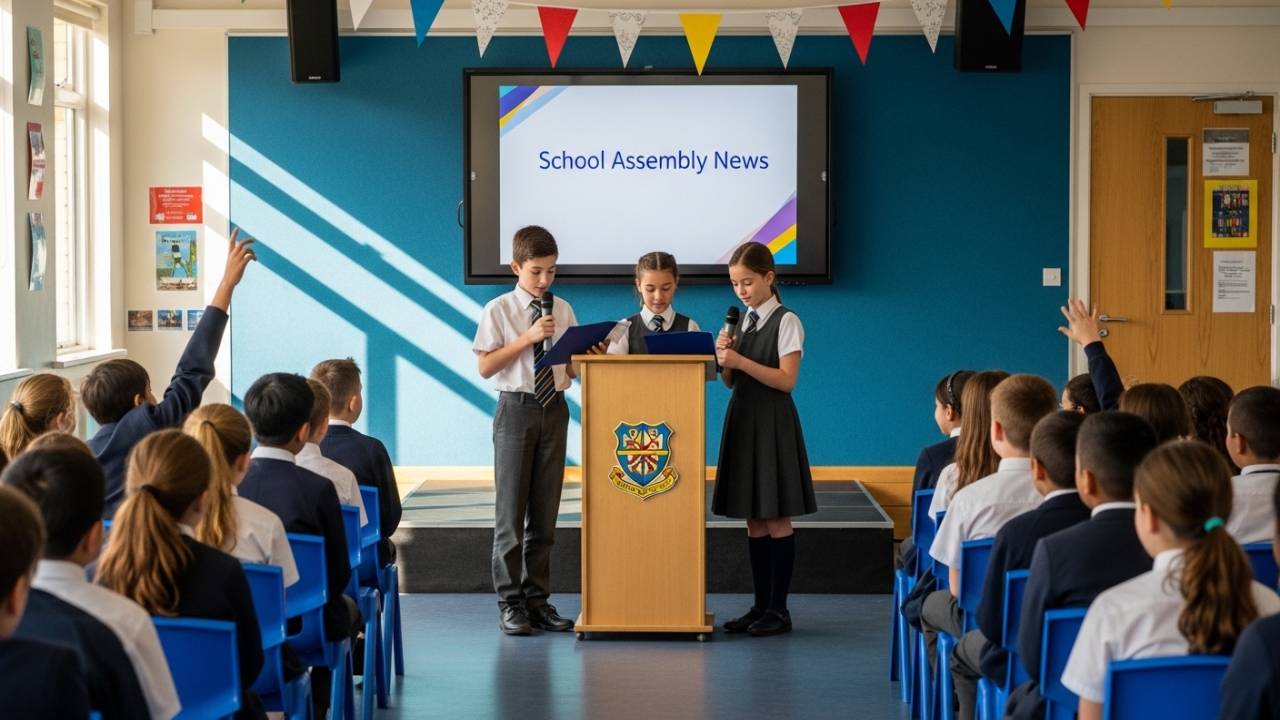
Before jumping into scripts, let’s understand what this segment is actually supposed to do.
The news reading segment in a school morning assembly serves three purposes. First, it keeps students informed about what is happening in the world — internationally, nationally, and locally. Second, it develops the communication and public speaking skills of the student who reads. Third, it adds a structured, professional element to the assembly that mirrors real-world practices.
A typical school news reading segment lasts between 3 and 5 minutes. In that time, the student anchor is expected to cover 4 to 6 headlines across different categories — world news, national news, sports, weather, and sometimes science or education.
The segment has three distinct parts that every news reader must master:
| Part | What It Is | Time |
|---|---|---|
| Intro | Opening lines that greet and engage | 15–20 seconds |
| News + Transitions | The actual headlines with connecting lines | 2–3 minutes |
| Outro | Closing sign-off lines | 15–20 seconds |
Miss any one of these three parts and the presentation feels incomplete, no matter how good the headlines are.
Part 1 — The Professional Intro (How to Start the News Segment)
The biggest mistake students make is starting with just “Good Morning. Today’s news is…” and immediately reading the first headline. This sounds robotic and gives the audience no time to tune in.
A good intro does three things — it greets the audience, it creates a moment of attention, and it establishes you as a confident presenter before you say a single news headline.
Here are four different intro options for different situations.
Option 1 — The Formal Intro (Safe for All Schools)
“Good morning to our respected Principal, our dedicated teachers, and my dear fellow students.
I am [Your Name] from Class [X], and I have the honour of presenting the news headlines for today, [Day], [Date].
Let us stay informed, stay aware, and stay ahead. Here are today’s top stories.”
Option 2 — The Creative Intro (Great for Senior Students)
“A very warm good morning, everyone.
It is said that an informed mind is a powerful mind. So let us begin our day the right way — by understanding the world around us.
I am [Your Name] with today’s morning news digest. Let’s get started.”
Option 3 — The Quote-Based Intro (Best for Making an Impression)
“Good morning everyone.
Thomas Jefferson once said — ‘An informed citizenry is the only true repository of the public will.’ In other words, knowing what is happening around us makes us better people and better citizens.
I am [Your Name] from Class [X], and here are your news headlines for [Date].”
Option 4 — The Two-Anchor Intro (For Schools With Pair Reading)
Anchor 1: “Good morning respected Principal, teachers, and dear friends. I am [Name 1] from Class [X].”
Anchor 2: “And I am [Name 2] from Class [X]. Together, we bring you the top news headlines for today, [Date].”
Both: “Let’s begin.”
Part 2 — Transition Lines: The Real Skill of News Reading
If the intro gets attention, transition lines are what make you sound professional. These are the connecting sentences you say between one news category and the next.
Without transitions: “Modi ji visited Japan. Virat Kohli scored 150 runs. Weather is sunny.” — Sounds like a shopping list.
With transitions: “Shifting now from national affairs to the world of sport…” — Sounds like a real news anchor.
Here is a complete, category-wise collection of transition lines you can use.
Also Read:- Anchoring Script to Introduce Guests at Events | Word-for-Word Scripts, Templates & Tips (2026)
Transition Lines — International News
Use these when you are beginning the news segment or moving to world updates.
- “Let us begin by casting our eyes on the international stage.”
- “Starting with updates from around the globe…”
- “On the world front this morning…”
- “Making headlines internationally today…”
- “Our first stop is the global arena, where…”
Transition Lines — National News (India)
Use these when moving from international to Indian news.
- “Now, closer to home. Here are the latest national updates from India.”
- “Bringing our focus back to our own country…”
- “On the domestic front, here is what is making news today.”
- “Shifting to the national scene, there are important developments to share.”
- “What is buzzing in India today? Let us find out.”
Transition Lines — Sports News
Use these when moving from national news to sports. Change your voice slightly — sound a little more energetic here.
- “Now, time for some action! Let us step into the sports arena.”
- “For all the sports enthusiasts in our assembly, here are the latest updates.”
- “Blowing the whistle and moving to sports…”
- “From fields and courts and tracks around the world — here is the sports bulletin.”
- “And now, the segment many of you have been waiting for — sports!”
Transition Lines — Science and Technology News
- “In the world of science and innovation…”
- “Technology never sleeps, and neither does progress. Here is the latest from the world of science and tech.”
- “Moving to a topic that will shape our future — science and technology.”
Transition Lines — Education and Youth News
- “And now, a story that directly concerns all of us as students…”
- “In education news, which affects every student and teacher in this hall…”
- “Here is a development that our student community should know about.”
Transition Lines — Weather Report
Always deliver the weather last. Keep the tone calm and conversational.
- “Before we sign off, let us check in with the weather.”
- “And finally, here is what the sky has in store for us today.”
- “Wrapping up with the weather forecast for [City/Region] today.”
- “One last update — and this one affects all of us directly — the weather report.”
Also Read:- Anchoring Script for Independence Day Celebration in School (2026) — Complete Guide for Students & Teachers
Part 3 — The Outro: How to End Properly
Never end with “That’s it.” Never stop abruptly after the last headline. A proper sign-off takes only 15 seconds but leaves a lasting impression of professionalism.
Outro Option 1 — Simple and Clean
“Those were the major headlines for this morning. Thank you for listening, and have a wonderful, productive day ahead.”
Outro Option 2 — Professional Sign-Off
“That brings us to the end of today’s news bulletin. Stay curious, stay informed, and remember — knowledge is the best investment you can ever make. This is [Your Name], signing off. Thank you and good morning!”
Outro Option 3 — Motivational Close
“These were today’s top stories from around the world and our nation. Let the events of the world remind us of our own responsibilities — as students, as citizens, and as future leaders. Have a great day, everyone. Thank you.”
Outro for Two-Anchor Format
Anchor 1: “That is all for today’s news headlines.”
Anchor 2: “Stay aware, stay inspired, and stay curious.”
Both: “This is [Name 1] and [Name 2], signing off. Thank you and good morning!”
Complete Sample Script 1 — Standard Monday Morning Assembly
Here is a full, ready-to-use news reading script. Replace the headlines with actual current events.
“Good morning to our respected Principal, teachers, and my dear friends.
I am [Your Name] from Class [X], with today’s news headlines for [Day, Date].
Starting with international news — The United Nations has called for an emergency session to address the ongoing humanitarian crisis in [Country]. World leaders are expected to respond by the end of this week.
In economic news, the International Monetary Fund has revised India’s GDP growth forecast upward for the current financial year, reflecting strong domestic consumption.
Coming now to national headlines — The Indian government has launched a new initiative to promote digital literacy across rural schools in five states, benefiting over two lakh students.
The Indian Railways has announced the addition of fifteen new Vande Bharat Express routes across the country, connecting previously underserved regions.
Moving to the sports arena — The Indian cricket team has won the second Test match against [Country] by an innings and 40 runs, taking a 2-0 lead in the series. A brilliant performance all round!
In athletics, Indian sprinter [Name] has broken the national 100-metre record at the national championships held yesterday.
And finally, before we go — today’s weather. The weather in [City] today will be mostly clear with a maximum temperature of [X] degrees Celsius. No rain is expected. A pleasant day lies ahead!
These were the major headlines for this morning. Stay informed, stay inspired. This is [Your Name], signing off. Good morning and have a wonderful day!”
Complete Sample Script 2 — Two-Anchor Format
Anchor 1: “Good morning everyone. I am [Name 1] from Class [X].”
Anchor 2: “And I am [Name 2] from Class [X]. Together, we bring you today’s news headlines for [Date].”
Anchor 1: “Let us begin with international news. The G20 Summit is currently underway in [Location], with world leaders discussing climate change, global trade, and artificial intelligence governance.”
Anchor 2: “Coming to national updates — the CBSE has officially released the timetable for the upcoming Class 10 and Class 12 board examinations. Students are advised to visit the official website for details.”
Anchor 1: “In sports — India defeated [Country] in the semifinal of the Under-19 Asia Cup, and will face [Country] in the final this Saturday.”
Anchor 2: “And for the weather — skies over [City] will remain clear today with a pleasant temperature of around [X] degrees. A good day to be outdoors!”
Anchor 1: “That concludes today’s bulletin.”
Anchor 2: “Stay curious, stay aware.”
Both: “This is [Name 1] and [Name 2]. Good morning and have a great day ahead!”
How to Deliver the News Like a Professional: 7 Practical Tips
Knowing what to say is only half the job. Here is how to say it well.
| Tip | What to Do | Why It Matters |
|---|---|---|
| 1. Make Eye Contact | Read one sentence, then look up for 2 seconds | Builds trust and connection with the audience |
| 2. Control Your Pace | Speak slowly and clearly — do not rush | Fast speaking makes the audience tune out |
| 3. Match Tone to Content | Slow and serious for tragic news; energetic for sports | Shows emotional intelligence and keeps audience engaged |
| 4. Use a Folder or Clipboard | Never hold loose papers | Looks professional; reduces visible nervousness |
| 5. Pause Between Categories | Take a breath before each transition line | Helps audience follow the shift in topic |
| 6. Rehearse Once Before Assembly | Read aloud at home or in the corridor | Catches pronunciation problems before they happen on stage |
| 7. Avoid Filler Words | No “umm”, “like”, “so basically” | These words destroy credibility instantly |
Also Read:- International Women’s Day Anchoring Script in English
Common Mistakes Students Make in News Reading
Knowing what not to do is just as important as knowing what to do.
Reading in a monotone voice is the most common problem. News is not poetry — but it is not a flat recitation either. Your voice should go up slightly when introducing a segment and come down when wrapping up. Vary your energy based on the category.
Forgetting to mention the date makes the reading feel untethered. Always state the day and date in your intro. It anchors the news in time and adds credibility.
Reading too many headlines kills attention. Four to six headlines is the sweet spot for a morning assembly. More than that and students stop listening after the third one.
No transition between categories makes you sound like a robot listing facts. Even one sentence of transition — just one — makes a world of difference to how professional you sound.
Ending abruptly after the last headline is one of the most jarring experiences in a school assembly. Always have your outro memorised and ready, even if everything else is on paper.
Ignoring pronunciation of difficult names is dangerous. If you have a challenging foreign name, a scientific term, or an unfamiliar place name in your headlines, look it up the night before. If you get it wrong on stage, simply say “correction” calmly and say it again. Do not freeze or apologise excessively.
Quick Reference Card: What to Say at Each Stage
| Stage | Example Line |
|---|---|
| Opening | “Good morning. I am [Name] from Class [X] with today’s headlines for [Date].” |
| Start International | “Let us begin on the international front…” |
| Move to National | “Bringing our focus back to India…” |
| Move to Sports | “Now, stepping into the sports arena…” |
| Move to Science/Tech | “In the world of science and innovation…” |
| Weather Intro | “And finally, today’s weather forecast…” |
| Closing | “These were today’s headlines. This is [Name], signing off. Good morning!” |
Frequently Asked Questions
Q1. How many headlines should I read in school assembly? Stick to 4 to 6 headlines. One or two from international news, two from national news, one from sports, and one weather update. More than six will lose the audience’s attention before you finish.
Q2. Where should I get today’s news from? Reliable sources include the websites of Times of India, The Hindu, NDTV, and BBC India. Check the news the night before or early in the morning. Write down only confirmed, factual stories.
Q3. Can I read from my phone on stage? Most schools consider it informal to look at a phone on stage. Print the headlines on a sheet or write them neatly, then place them inside a folder or clipboard for a clean, professional look.
Q4. What do I do if I mispronounce a name? Stay calm. Simply say “correction” quietly and pronounce it correctly. Even professional news anchors on television correct themselves sometimes. The audience respects composure far more than perfection.
Q5. Should I explain the news or just read the headlines? In a morning assembly setting, stick to headlines — one or two sentences per story. You are not expected to analyse or explain. Keep it crisp so the segment stays within the allocated time.
Q6. How do I make my news reading more impressive than others? Three things set great news readers apart from average ones: a strong, confident intro; smooth transition lines between categories; and a clear, memorable sign-off. If you master these three elements, you will always stand out.
Q7. Can I add a thought or quote to the news reading? Yes — and it works beautifully when done right. A relevant quote tied to one of the news stories adds depth and shows that you have thought about the content, not just read it. Keep it brief — one sentence is enough.
Conclusion: The News Segment Is Your Moment
The school assembly news reading segment is often treated as a minor task. But for the student at the microphone, it is a genuine opportunity — a chance to practise public speaking, build confidence, and develop a skill that will serve you in debates, interviews, presentations, and every professional situation that lies ahead.
Every great communicator started somewhere. Many of India’s finest journalists, politicians, and public speakers trace their confidence back to standing in a school hall just like yours, holding a paper just like yours, speaking to an audience just like yours.
Use this guide. Prepare your intro. Memorise at least two transition lines for each category. Have your outro ready. And when you step to that microphone tomorrow morning — speak clearly, look up, and own the moment.