
Introduction: A Day the Nation Wept
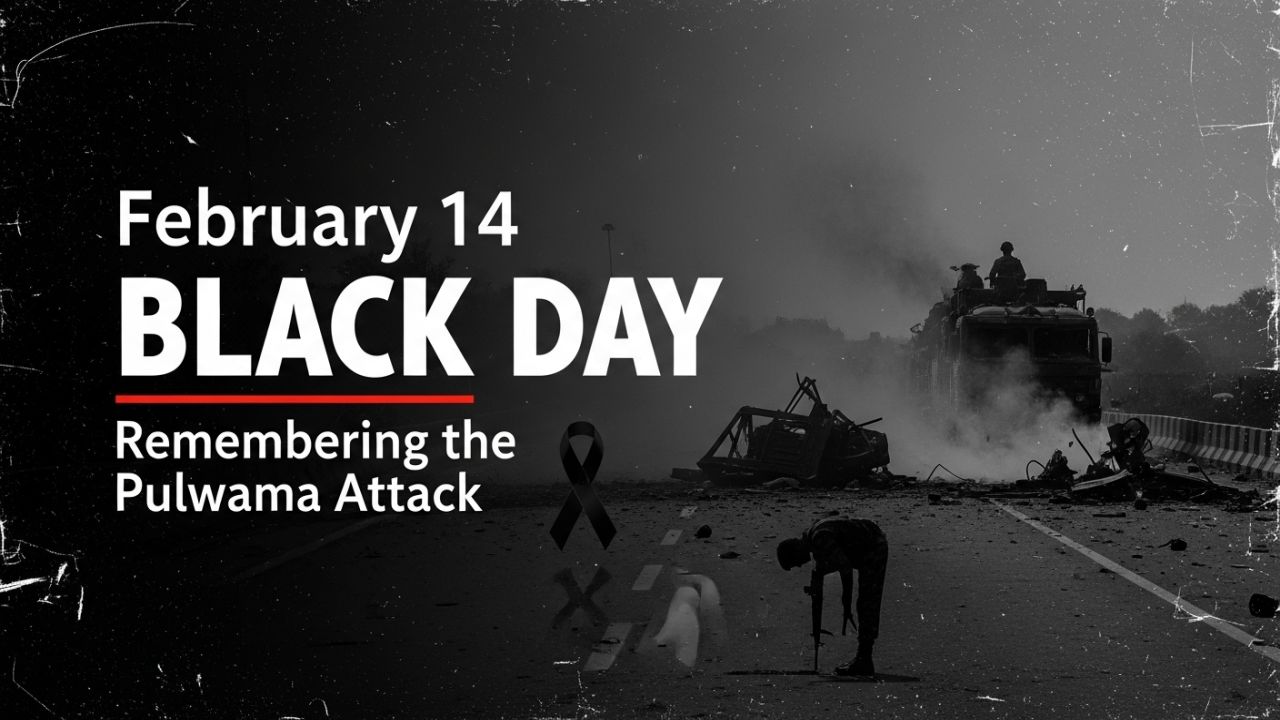
Every year, February 14 brings images of roses, chocolates, and celebrations of love across the world. But for India, this date carries an entirely different and deeply painful meaning. February 14 is solemnly observed as Black Day — a day of national mourning and remembrance in honor of the brave soldiers who lost their lives in one of the most devastating terrorist attacks ever carried out on Indian soil.
The 2019 Pulwama attack, which took place in the Pulwama district of Jammu and Kashmir, shook the conscience of the entire nation. In a matter of seconds, a car bomb tore through a convoy of Central Reserve Police Force (CRPF) personnel, killing 40 soldiers and injuring dozens more. The tragedy not only brought grief to hundreds of families but also pushed India and Pakistan to the edge of a major military confrontation.
This article commemorates the Pulwama attack Black Day on February 14, revisiting the events of that terrible afternoon, honoring the heroes who made the ultimate sacrifice, and examining how this tragedy reshaped India’s national security narrative.
What Happened on February 14, 2019?
The Attack
On the afternoon of February 14, 2019, a convoy of approximately 78 vehicles carrying around 2,500 CRPF personnel was traveling from Jammu to Srinagar on the Jammu–Srinagar National Highway. The convoy passed through the Lethapora area in the Pulwama district of Jammu and Kashmir.
At approximately 3:15 PM, a Maruti Eeco car loaded with over 300 kilograms of explosives rammed into one of the buses carrying CRPF jawans. The explosion was so powerful that the bus was completely destroyed and its wreckage was scattered across a wide area. The blast was heard kilometers away, and the scale of the carnage was immediately clear.
Forty Central Reserve Police Force soldiers were killed instantly or succumbed to their injuries shortly after. It was the single deadliest terrorist attack on Indian security forces in decades, and the nation went into a state of immediate shock and mourning.
Who Claimed Responsibility?
The Jaish-e-Mohammed (JeM), a Pakistan-based terrorist organization, claimed responsibility for the attack. The suicide bomber was identified as Adil Ahmad Dar, a 19-year-old local resident from Kakapora in Pulwama, who had reportedly joined the militant group about a year before the attack.
The National Investigation Agency (NIA) later confirmed that Pakistani nationals, with the support of JeM leadership operating from Pakistan, had planned and coordinated the attack. The use of a local recruit as the bomber was a calculated tactic to avoid detection by security forces.
Also Read:- Holi Anchoring Script 2026: Complete Guide for School Assembly with Eco-Friendly Ideas
The Martyrs: Heroes Who Gave Everything
The 40 CRPF soldiers who were martyred in the Pulwama attack came from different corners of India — from Uttar Pradesh to Maharashtra, from Rajasthan to Himachal Pradesh. They belonged to different religions, different cultures, and different backgrounds, but they stood united under one flag.
Many of the martyrs were young men in their 20s and 30s, some of whom had recently gotten married or just become fathers. Their deaths left behind grieving wives, young children, and heartbroken parents. The nation watched in tears as their bodies were brought home, and the sight of their families — especially their young children — sent a wave of sorrow across the country.
Among those remembered with the highest honor:
- Head Constable Jaswant Singh Negi, who had just returned from leave.
- Constable Maninder Singh Attri, who was due to retire within months.
- CRPF Jawan Niraj Kumar Singh, who was set to get married shortly after the attack.
- Sepoy Bablu Santra, the youngest among the fallen, barely in his early twenties.
Each of these soldiers represents thousands of unsung heroes who serve in conflict zones far from their homes, protecting the rest of India so that others may live in peace.
Why February 14 is Called “Black Day”
In the immediate aftermath of the Pulwama attack, February 14 was designated as Black Day by various organizations, political leaders, and citizens across India. The idea was simple but deeply meaningful: while the world painted the day red for love, India would paint it black — for sacrifice, for grief, and for solidarity with those who lost their lives.
Every year on this date, citizens observe Black Day in the following ways:
- Flying the national flag at half-mast.
- Lighting candles and holding vigils at public places.
- Sharing tributes on social media with the hashtags #PulwamaAttack and #BlackDay.
- Schools, colleges, and organizations across India holding moments of silence.
- News channels and public figures replaying the bravery of the fallen jawans.
The observance of Black Day is not just about mourning — it is a collective commitment by Indians to never forget the sacrifice of their soldiers. It is a reminder that peace comes at a price, and that price is paid by the brave men and women who stand at the nation’s borders and in its conflict zones every single day.
India’s Response: Operation Balakot Airstrike
The Pulwama attack did not go unanswered. The Indian government, led by Prime Minister Narendra Modi, immediately held high-level security meetings. Diplomatic channels were activated, and India began building a global case against Pakistan for harboring terrorist organizations like JeM.
Diplomatic Offensive
India swiftly took several diplomatic measures:
- Most Favoured Nation (MFN) status, which India had granted to Pakistan, was revoked.
- India imposed 200% import duties on Pakistani goods.
- India launched a major diplomatic outreach, briefing foreign governments and international organizations about Pakistan’s role in sponsoring cross-border terrorism.
- India demanded that Pakistan take immediate action against JeM and its chief, Masood Azhar.
The Balakot Airstrike — February 26, 2019
Exactly 12 days after the Pulwama attack, on February 26, 2019, the Indian Air Force launched a pre-dawn airstrike deep inside Pakistani territory. IAF Mirage 2000 jets crossed the Line of Control and struck what India described as the “biggest training camp” of Jaish-e-Mohammed in Balakot, Khyber Pakhtunkhwa province of Pakistan.
This was the first time since the 1971 war that India had conducted an airstrike inside Pakistan’s territory. The operation, widely known as the Balakot Airstrike, was a watershed moment in India-Pakistan relations and was welcomed by the majority of Indians as a decisive and bold response to terrorism.
The following day, on February 27, Pakistan sent fighter jets to retaliate. In the ensuing aerial engagement, Indian Air Force pilot Wing Commander Abhinandan Varthaman’s MiG-21 was shot down and he was captured by Pakistan. After intense diplomatic pressure from India and the international community, Pakistan released him on March 1, 2019. Wing Commander Abhinandan returned to India as a national hero and was later promoted to Group Captain and awarded the Vir Chakra for his bravery.
The Investigation and Legal Action
The NIA took over the investigation into the Pulwama attack and made significant progress in identifying the perpetrators and their network.
Key findings of the investigation included:
- Adil Ahmad Dar, the suicide bomber, was identified using DNA profiling.
- A local network of overground workers (OGWs) had provided logistical support, including shelter and the explosive material.
- The investigation confirmed active involvement and planning by JeM operatives based in Pakistan.
Several individuals connected to the attack were arrested over the following months and years. The NIA filed chargesheets against multiple accused, including JeM chief Masood Azhar and his brother, Rauf Asghar.
In 2020, the United Nations Security Council finally designated Masood Azhar as a global terrorist — a step that had been blocked multiple times by China in previous years, but which India had persistently advocated for.
Also Read:- 15+Inspiring Thoughts of the Day for School Assembly (English & Hindi Explained)
Impact on India’s National Security Policy
The Pulwama attack had a profound and lasting impact on how India approaches national security, counterterrorism, and its relationship with Pakistan.
Change in Counter-Terror Doctrine
One of the most significant shifts was India’s willingness to go beyond its borders to neutralize terrorist threats. The Balakot airstrike demonstrated that India was no longer going to limit its response to diplomatic protests. This marked a clear shift in India’s strategic doctrine — from “strategic restraint” to “proactive deterrence.”
Enhanced Security for CRPF Convoys
Following the attack, the CRPF and the Ministry of Home Affairs undertook a comprehensive review of security protocols for troop movements. Measures introduced included:
- Air transport for large troop movements in conflict zones.
- Anti-mine protection vehicles and better-armored transportation.
- Improved real-time intelligence sharing between agencies.
- Stricter checks on the highway during convoy movements.
Public Awareness and Solidarity
The Pulwama attack sparked an unprecedented wave of public solidarity with the Indian Armed Forces. Millions of citizens across the country took to the streets and to social media to pay tribute to the martyrs. The sacrifice of the soldiers became a unifying moment for Indians across political and regional divides.
The Families Left Behind: A Nation’s Responsibility
Perhaps the most heart-wrenching consequence of the Pulwama attack is the suffering of the families who were left behind. Forty families lost their primary breadwinners. Hundreds of children lost their fathers. Elderly parents lost their sons.
The government of India, as well as several state governments, announced financial compensation, government jobs for family members, and educational scholarships for the children of the martyrs. Various private organizations and citizens also contributed to relief funds.
However, no amount of financial support can fill the void left behind. The wives of the martyrs have often spoken in interviews about how they struggle to explain to their young children why their fathers will never come home again. These stories continue to remind Indians of the true cost of the freedom and security they enjoy.
Remembering Pulwama: Why It Still Matters in 2026
Seven years have passed since the Pulwama attack, but its memory remains fresh and the wounds have not fully healed. In 2026, as India observes the anniversary of the attack as Black Day on February 14, the nation continues to reflect on several important questions:
- Has cross-border terrorism from Pakistan been effectively curtailed?
- Are the families of the martyrs being properly taken care of?
- Is India’s national security framework strong enough to prevent such attacks in the future?
The answers to these questions are complex, but the commitment of the Indian state and its citizens to never forget the Pulwama martyrs is unwavering. Every year, February 14 serves as a reminder that the price of peace is eternal vigilance, and that the bravery of India’s security forces deserves not just honor on one day, but sustained respect and support throughout the year.
Also Read:- How to Write a Graduation Speech: Complete Guide with Template
How You Can Pay Tribute on Black Day
If you want to honor the memory of the Pulwama martyrs on this Black Day, here are some meaningful ways to do so:
- Light a candle at home or at a public memorial in the evening.
- Share a tribute post on social media using #PulwamaBlackDay and #NeverForgottenPulwama.
- Donate to the CRPF Welfare and Rehabilitation Board or other verified organizations that support the families of fallen soldiers.
- Educate the younger generation by talking to children about the sacrifice of India’s soldiers.
- Watch documentaries or read books about the Pulwama attack and the broader issue of cross-border terrorism.
- Fly the national flag at half-mast as a mark of respect.
These small acts of remembrance collectively send a powerful message: India has not forgotten, and India will not forget.
Conclusion: Love and Sacrifice — February 14’s Dual Identity
February 14 will always hold a dual identity for India. For the rest of the world, it may be a day of romance and celebration. But for Indians, it is a day that demands silence, reflection, and deep respect for those who laid down their lives in the line of duty.
The Pulwama attack of 2019 tested India’s resolve, but it also revealed the strength of the nation’s spirit. It showed the world that India would mourn its fallen with dignity, respond to aggression with determination, and stand firmly behind its security forces in times of crisis.
As we observe Black Day on February 14, 2026, let us bow our heads in gratitude and remembrance. Let us honor the 40 brave souls of Pulwama and the countless other soldiers who continue to stand guard so that the rest of the nation may sleep peacefully.
Jai Hind. Jai Jawan.
This article has been written to honor the memory of the CRPF martyrs of the Pulwama attack. All facts are based on official records, government statements, and credible news reports.